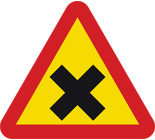
> Vissa korsningar har en stoppskylt vid varje väg, ett så kallat flervägsstopp. Det innebär att alla som kommer till korsningen måste stanna, oavsett vilken väg man kommer på. Tanken är att man vid flervägsstopp ska ta ögonkontakt med medtrafikanter för att på så sätt komma överens om vem som ska köra först.
Or my translation "Certain intersections have a stop sign at every way, a so-called multi-way stop. This means that everyone who comes to the intersection must stop, despite which way they come from. The thought is that people at the multi-way stop will make eye contact with their fellow drivers in order to come to an agreement on who shall drive first.
(Apparently the actual law says "ömsesidig hänsyn" - "mutual consideration.")
That said, they aren't anywhere near as common as the US.
Do you actually have them in Sweden? I was taught similar rules back when getting a driving licence, but it doesn't neccessarily mean that such intersections exist - I was told about intersections that were like that in 1960ies, but those spots have traffic lights now.
I biked through one yesterday, in Trollhättan. If you do an image search for "flervägsstopp" you'll find several images, including this one which is specifically a four-way stop: http://www.trafikmagasinet.nu/art090503.htm .
Hej! Another Trollhättebo! Yeah, I actually passed a couple on my ride, though I only mentioned one. As an American my baseline is the number of 4-way stops in the US. I've only lived in Gothenburg and here, which gives a poor sampling bias.
Oh? At least in Germany it's that you have to yield to a driver to the right (ignoring priority roads) but if you have an intersection of non-priority roads and a car from each direction someone has to make a decision to go first, otherwise it's a deadlock.
Europe doesn't generally use 4-way stop signs (http://en.wikipedia.org/wiki/All-way_stop) in the traffic regulations; intersections tend to be either regulated, or with one road designated as the priority, or as roundabouts, not like this.
I've driven a bit around Europe, but I have never seen a single such intersection in my life - if they exist, they must be rare.
Of course, "if you have an intersection of non-priority roads and a car from each direction" then it's the same, but in practice it seems that 'they' make sure that such intersections are only in extremely low-traffic places where you'll very rarely see another car at the same time.
In Sweden as soon as you're in a residential area or out in the countryside, unmarked priority-to-the-right crossings are the norm. And if cars from all directions in a crossing arrive at once, you end up with an ambiguous 4-way stop situation.
In creating an autonomous car, successfully handling those rare edge cases are going to be the thing that differentiates success from failure. Roundabouts and Michigan left turns are rare in most places in the US, but an autonomous car would still have to be able to handle them.
In Europe you can have ambiguous situations with the priority to the right, where you are supposed to be courteous and wave the driver if both (or more) have the right of way.