> A few years later, after a woman in Pennsylvania sent Heinz a dozen bottles of her homemade, tastier, better-looking, benzoate-free ketchup, they adopted her recipe, which was also sweet, vinegary, and thick.
So the person responsible for the taste of ketchup, a woman, is barely alluded to, and not even named?
I don't think of myself as a feminist, but this is pushing it.
It's a quote from "Pure Ketchup: A History of America's National Condiment" by Andrew F. Smith, who appears to be the only source I could find for this claim.
The book cites the following as a reference: "Testimony of Sebastian Mueller, Curtice Brothers v. Harry E. Barnard et al., in the United States Circuit Court of Appeals, 4:2989-995; Testimony of G. F. Mason, Curtice Brothers v. Harry E. Barnard et al., in the United States Circuit Court of Appeals, 4:2966, in the National Archives-Great Lakes Region, Chicago"
A quick search on "Curtice Brothers v. Harry E. Barnard" only refers back to the book. Didn't care to look beyond that to see if the case is online.
The opinion for this case appears to be accessible here: https://cite.case.law/f/209/589/ (it's 209 F. 589, for anyone who knows how to turn that cite into a usable opinion).
From scanning the opinion, it looks like the book cite is referring to testimony before a special master, probably convened to look into the factual matter of whether or not benzoate is a harmful chemical.
The case itself is on Westlaw at least, but the opinion doesn't mention Heinz at all. PACER only goes back to 1989, so I suspect you'd have to actually go to Chicago in person to read the testimony.
A "fun" fact about Heinz Ketchup, especially considering the brand's history with the condiment, is that Osem, an Israeli food company, had successfully lobbied the regulator to prohibit Heinz from calling it's ketchup ketchup, due to it "not containing enough tomatoes".
My bottle of Heinz right here on the ingredient list says: "Ingredients: Tomatoes (200g per 100g Tomato Ketchup), vinegar, lemon juice from concentrate, potassium chloride, acid (malic acid), citrus fiber, spice and herb extracts (contain CELERY), sweetener (sucralose)" how many more tomatoes does it need?
200g of tomato per 100g of ketchup is a very weird way of putting it, but if I understand how they’ve written it to mean 200g of tomato goes into each 100g portion of ketchup, then that’s basically 10g of tomato solids for each 100g of ketchup (assuming 95% of tomato is water, which I think it is). Doesn’t actually seem like that much.
Disclaimer - I am not a smart person and could be very wrong on all of this.
I've checked some other brands online and it makes me wonder if it's due to a local ketchup law or simply a marketing thing. Store brand 156 per 100, organic store brand 120 per 100, competing brand 140 per 100, a different competing brand 180 per 100, Heinz classic 148 per 100, Heinz organic 180 per 100. They all mention it.
By that reasoning if you sold someone a tomato, that's 10g of tomato solids for each 200g of tomato, and actual tomatoes need to be labelled as "contains 5% tomato".
Not really, the tomato is 5% tomato solids and 100% tomato. The ketchup is some percentage solids and another percentage vinegar, so unless they use tomato vinegar..
This is just cronyism, so "how many tomatoes does it need" is an ever shifting line that is always somewhere in the middle between how many Heinz use and how many Osem use. IIRC the actual difference is rather small.
(Well, this isn't strictly true, IIRC there have been a few changes over the years to both of their recipes and the regulations and Heinz were allowed to call themselves Ketchup for some of the time, but you get my point)
its sort of true, but doesn't seem to be fully enforced. Heinz's Mayochup is sold in Israel as "רוטב בטעם מיונז ןקטשופ" (sauce in the flavor of of mayonnaise and ketchup, and yes, they spell the last word without a sofit form). Now, perhaps they can get around it because its "sauce in the flavor of ketchup" and not simply "ketchup", but then I dont know why they would just label it regularly as that.
Personally, I prefer heinz "not ketchup" to osem brand, but that can be my american trained pallate.
I'd translate it as "Tomato Dip", though strictly speaking that may be an inaccruate translation. A "dip" in Hebrew should be מטבל since ט.ב.ל. is a root that means "to dip" so מטבל would be a "thing" for dipping. Heinz's sauce however is מתבל which is a homonym but has a different root ת.ב.ל. which that relates to spices. Strictly speaking that isn't an official word then, but you can understand they are evoking both "Dip" and "Spice" with their chosen "word".
IIRC while the labeling in Hebrew uses that word, the bottles still have their original labels in English (on the other side of the bottle) saying "Ketchup", making the whole affair extra stupid.
Related to the death of other tomato ketchups; tomato was not the original dominant ketchup in the US. Mushroom ketchups predate tomato ketchup by a century.
The above push in the article also made most other commercial ketchups go extinct, and few people bottle homemade sauces today for their own use.
But also, the taste. Heinz ketchup is a universe away from, say, a Vietnamese fish sauce. (Worcestershire is another sauce in the same vein.) Americans are much more liberal with sweet, thick ketchup than with anything fermented and sour.
I also wanted that too (and a good mug of tea!), but when I travelled back home I found that the HP sauce was somehow less tasty and had less zing. Dunno if it's me or if they changed it.
As with most food history a lot of this is debated. One version is that the British encountered a fermented fish sauce somewhere in Asia and transliterated the name as ketchup. They then liked it, and tried to reverse engineer it with what was available at home and what they remembered of the taste. Ketchup shows up in the Oxford English Dictionary in 1682.
The English bring their recipes to the United States, and their descendants make mushroom ketchups, but also walnut ketchups, oyster ketchups, and all sorts of things. As late as 1913 Webster defines ketchup listing mushroom first, then tomato, then walnut.
Tomato ketchup becomes dominant in the early 20th century through the events described in this article, which not only destroyed most of Heinz’s tomato competition but all the other ketchups too.
There are also other, more modern ketchups. A personal favorite is Filipino banana ketchup, which was developed when that country was cut off from tomatoes during WWII.
In Malaysia and particularly Indonesia, a great many sauces are to this day called kecap, pronounced "ketchup". The debate is mostly about whether the Indonesian kecap inspired the Chinese ke-tsiap that eventually became Western ketchup, or the other way around.
I thought all ketchups were about the same, until a Polish friend brought some back with them (Pudliszki). I never knew ketchup could taste like actual tomatoes!
I find this very interesting, because Pudliszki is generally considered suspicious around here in Poland because it's laced with sugar.
For generations now children in kindergarten have been repeating the phrase "ketchup Pudliszki przeczyści Ci kiszki"("Pudliszki ketchup will clear out your guts").
Kotlin (no relation to the programming language. Or is there? We may never know) I believe has much less sugar.
Anyway if you ever get the chance go to McDonald's in Italy and ask for ketchup - it's 0,50€ per portion, but the taste is completely different than anywhere in Europe.
Ah Italy, they somehow handle anything tomato-related differently, and I mean better.
Currently baking alive on vacation in Sicily, tomatoes from basic stores taste much better than regular ones I can buy in Switzerland, any time of the year. When they do pasta with red sauce its something I want to pack and take home with us and just clone forever. I mean obviously their home made pasta al dente is superb, but those extra more-red-than-red sauces are also on another level.
Country seems a bit broken and drivers dont seem to recognize basic traffic rules, but food is up there, pretty consistently.
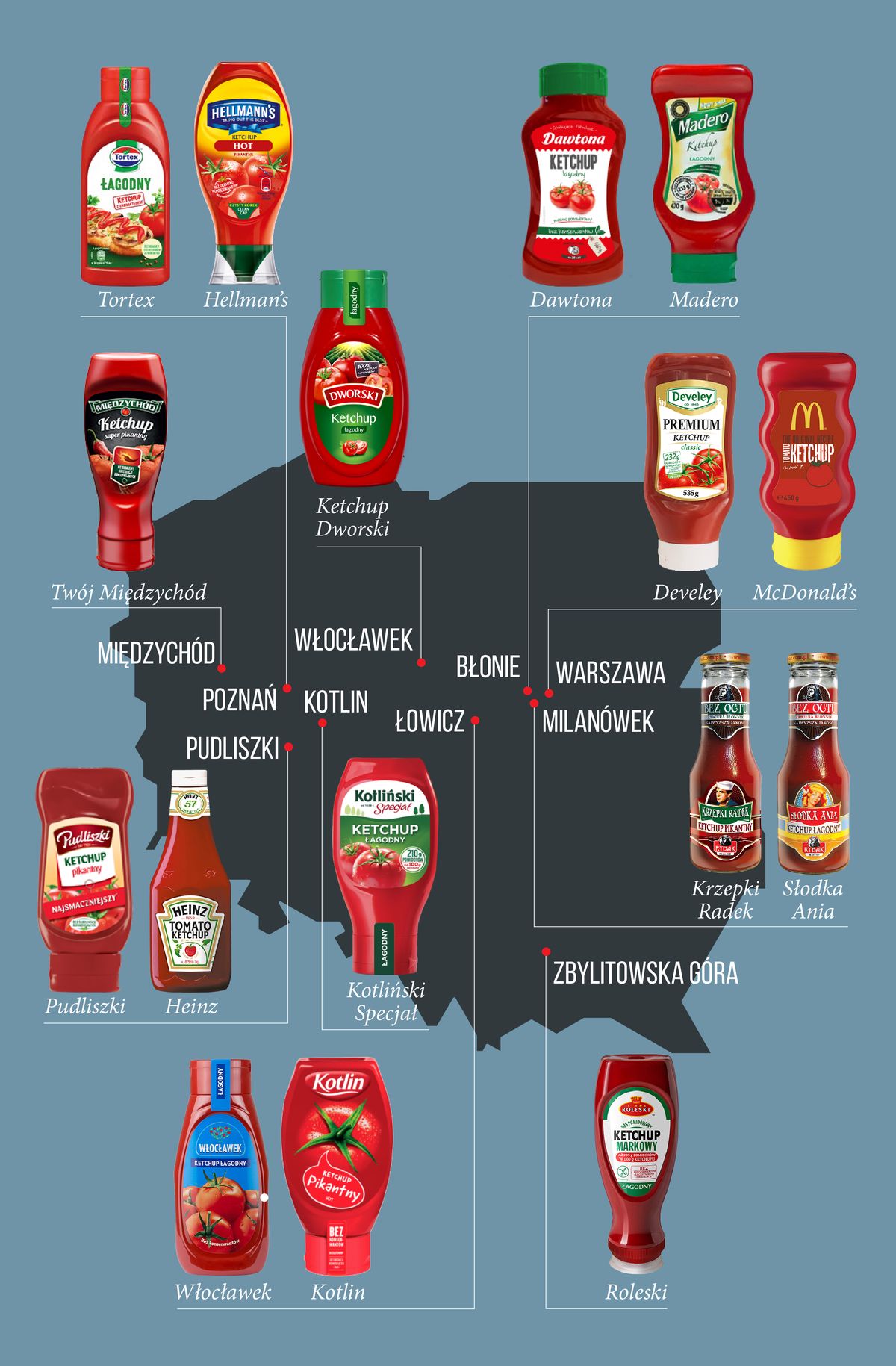
Since you mentioned Pudliszki and Kotlin, here's the Polish Map of Ketchup [1]. The Polish ketchup market is quite varied. The map shows where different ketchup brands are produced.
> The name comes from Kotlin Island, near St. Petersburg. Andrey Breslav mentioned that the team decided to name it after an island, just like Java was named after the Indonesian island of Java[13] (though the programming language Java was perhaps named after the coffee rather than the island).[14]
Here in Norway the most common ketchup, Idun Tomatketchup, is made especially for sausages like Vienna sausage. It's OK for its purpose, but is lacking for other uses, especially with more flavorful foods.
I preferred Heinz for some things, I quite like vinegar so, until I found a jar of some Country Ketchup from Stonewall Kitchen[1]. That's something else entirely, and I love it, especially for burgers and bratwursts.
So yeah, ketchup ain't just ketchup... not entirely unlike mustards.
So, I have a question: Is this available in the store or do you have to order it? And if so, are those stores located outside of Oslo as well? I'd totally pick up this ketchup if it is available here in Trondheim. (I already make special trips to one chain to get my preferred ketchup).
I found it at my local Meny here in Oslo. I see they have it in their web shop, direct link broken but search for "Country Ketchup", so good chance you'd get it up there in Trondheim. If they don't have it I'd ask. It's expensive but very flavorful so I find it lasts a good while.
edit: one of my fav combos is this on Jacob's Rå Bratwurst[1] with wholegrain buns. YMMV :)
If India is anything like South America, the ketchup is much more watery. Even Heinz. At first I thought it was a different recipe but they do it to make it cheaper by adding extra water. Same with packaging, lots of stuff in plastic bags instead of plastic bottles.
I started trying different ketchups after moving to Norway. I settled on one from Mutti - it is nice and thick and has a bit of texture while still being smooth and ketchupy, unlike Heinz (which is what I call standard ketchup).
Of course, Norway being Norway means that to get this ketchup, I have to stop by one particular grocery store chain as they are the only ones that sell it. If I can't make it there for whatever reason, though, Heinz it is. It is always a bit of a disappointment even though it is what I consumed for years.
I’ve only had Heinz until the Covid shortages, and I was forced to try Sir Kensington’s ketchup, and I will never buy Heinz again. Sir Kensington’s was thicker and tasted more like tomatoes.
It goes over an older Ketchup recipe and gives some related history. If you like historical food recipes and/or culinary history, you might want to check the channel out.
I hadn’t thought much about ketchup when my spouse brought home Heinz Organic Ketchup. I didn’t really think it would be any different, but it tasted awful! We ended up throwing it out after using it once or twice because it was just so different from what we were used to. A few years later they were out of the regular stuff at the local store, so we ended up with another version (also by Heinz) that uses Stevia instead of sugar. It is also disgusting.
I wouldn’t have thought of myself as any kind of ketchup purist or loyal to a brand or whatever, but I’ve become so accustomed to Heinz regular ketchup that even their other versions of the same brand taste wildly off to me.
It's interesting how different ketchup tastes can be, also culturally to some degree.
That green Heinz bottle, not the Stevia one, but with organic tomatoes and sugar, for some reason is one of the best big brand ketchups I've tasted. I don't like their normal ketchup tho, it's just to sweet for my taste.
Not quite twenty years ago, we happened to look into an old book of handwritten recipes belonging to my mother-in-law. On Labor Day weekend, we bought a big box of "seconds" tomatoes from a local farm stand, and spent the weekend cooking them down and making ketchup. We did the same the next summer; then we bought a fixer-upper house, and for some years had no lazy long weekends.
It was good ketchup, though our son (mid-teens) preferred the store-bought product. All it takes is time, which I suspect is at something of a premium among the HN crowd.
I remember seeing my mom add small quantities of ketchup in certain stews and other sauce-based dishes. To me, ketchup has the perfect balance of flavors and helps create umami. Even well-known chefs use it sparingly to improve their creations [1].
As someone who avoids 'prefab' products in cooking. Using a little tomato extract/paste and rounding the sauce/stew up later with some milk (for the sugars) pretty much creates the same result why people swear on ketchup.
I adapted this from Italian Cousine. A traditional bolognese works like that too.
Most of the ketchup I use at home ends up in my salad dressings...
The recipe I used is equal part olive oil and balsamic vinegar, Dijon mustard, Ketchup, pepper and some Herbes de Provence. The end result is a thick, strongly tasting vinaigrette, it doesn't go with every salad, but I like it a lot.
This probably sounds silly but is marketing why tomato sauce is often in sachets rather than added to your burger directly?
To explain: in most parts of the world unless you say no sauce the burger will have sauce added as they make it.
I've found in the US they give you a dry burger and then more sachets than you need of sauce. Which you then take and add yourself.
It's a minor weird difference. I find it an annoyance myself 'why do I need to put my own sauce on, can't they do it when they make it?'. I've always wondered why the US burger joints seem to consistently do it this way. The only thing I can guess is that they want to show you that it's Heinz sauce.
> I've found in the US they give you a dry burger and then more sachets than you need of sauce. Which you then take and add yourself.
Could you name a major fast food or fast casual chain that does this? Because it’s not typical. If not ketchup, a burger will have its standard option of a “special” usually Russian dressing style sauce option (the Big Mac special sauce, Shake Shack shack sauce, INOB spread, etc) - you can ask for ketchup, mustard and mayo to be added at any major fast food or fast casual chain - if it’s not standard. You can hold any condiment as well. The sachets are usually for fries.
This is factually incorrect. American fast food restaurants apply a standard dose of ketchup to each burger. Additional ketchup is provided, sometimes only on request, for patrons who prefer a "wetter" burger.
Source: I spent 21 years in the USA.
This is true for fast food establishments but many (most?) restaurants land your burger without ketchup unless specified. I'm grateful for it since there's a growing craft in creative alternative sauces.
That still doesn’t make the GP make any sense - the fancy places may have an alternative sauce by default so it’s not “dry”, as you note they’ll usually do it anyway by request, and if it’s fancy enough they’re not putting ketchup on by default they’re usually not just giving the packets of Heinz. I don’t think it’s about being an advertisement for Heinz. These places often are more likely to not use Heinz.
It's about personal taste: some people want no ketchup on a burger, others only a little, some want a lot. Separate ketchup gives the customer that choice.
Those little ketchup packs get thrown out a lot. The bottled stuff tastes better anyways.
I think has more to do with how varied it is how you want your ketchup on your burger. Ie. some like to put it on the patty evenly while others dip.
FWIW, this is also how ketchup is served at backyard bbqs: you give your friends a "dry" burger and direct them to where the ketchup, mustard, and other condiments are.
You should try Primal Kitchen ketchup. No added sugar but somehow still a bit sweet, probably from the tomatoes. If it's all I eat then I don't notice a difference, but if tried side by side with Heinz, Heinz tastes like sugar paste.
Are you from the US or another country? Heinz uses different ketchup recipes in different countries and I personally think there is a huge difference. In the US, it is by far the best ketchup, but I hate the heinz in Canada.
Where I'm from it's the opposite. Althought ketchup is a type of tomato sauce, tomato sauce usually refers to something with higher tomato content and more tomato taste where as ketchup is more vinegery and sweet.
That's a good question, and I don't know the answer. Presumably it's defined in some law somewhere. Why there exists such a law is a good question in itself.
In Russia "tomato sauce" is basically anything that has tomatos. But at the same time we have mostly sauses from Georgian, Turkish, Armenian etc causine. They have all kinds of spices (and often vegetables).
Ketchup is usually something far poorer in ingredients.
> I still can't unserstand why would anyone prefer Heinz to anything else. It has almost no flavor except vinegar...
Came here to say just this. I have a pretty undiscriminating and liberal palate and don’t really have that many dislikes when it comes to food. But Heinz ketchup is just bad. No flavor and just boring.
Then I had some "tomato jam" in a higher end restaurant and it was amazing and I realized it was just a nice house made ketchup. Since then I've also tried Red Gold ketchup and that's pretty darn good as well.
> "Heinz stood at the forefront of food hygiene, so regulations would only help the company command high prices and maintain its reputation."
I assume he's just saying it wouldn't have hurt, since those regulations also helped prevent a ton of people from getting sick from the preservatives that were poisoning them. I see the "regulations only ever benefit the big players in an industry" argument so often that seeing a line like that in an article seems more ambiguous than was probably intended.
> The first recorded recipe for a home-fermented tomato catsup was published in 1810, a descendant of British imitations of Asian “cat-sup,” or fermented fish sauce, that the British encountered on colonial voyages.
Do they mean kecap? Does this mean the similarity in name between ketchup and kecap is not a coincidence, but ketchup really started out as an imitation of the other. Must have been a hell of a journey, because today they are absolutely nothing alike.
It’s incredible to think that since the homemade catsups were home fermented they were rich in probiotics and digestive enzymes and naturally safe from food related pathogens. They were replaced with a product that, while safe is produced correctly, is more vulnerable to pathogens that are very deadly (c. botulinum). It really seems like a huge loss for public health.
In South Africa, the most popular brand is "All Gold Tomato Sauce", to be fair I can't reallly taste the difference, between a 'boerrie'[0] with heinz or all-gold.
[0] South African word for a "hot-dog" but the sausage is actually real meat sausage (boerewors), the sausage itself is kinda unique and amazing as well.
When I lived in a small village in Sweden, you couldn't get anything but Heinz or Felix. I don't think I could even get something like Coop store brand ketchup unless I traveled the 50 km to the city.
Felix's website^ says "Sverige har världens högsta konsumtion av tomatketchup" (Sweden has the world's highest consumption of tomato ketchup), though it doesn't say per capita or in total... I wouldn't be surprised if it was the latter. Sure! Let's put ketchup on spaghetti! On pizza! Why not!? :)
When I was a kid in Sweden in the early '80s I watched an educational film on TV about tomato ketchup containing carmine - red food colouring (E-120, natural red 4) made from crushed cochineal bugs.
I've never come across an actual tomato ketchup brand that contained food colouring. Did that even exist anywhere?
Looking at the felix.se and felix.at websites, it seems that probably Felix Austria was created in 1958 to serve the Austrian market. The Swedish website says Herbert Felix (a Czech immigrant to Sweden) started making pickles in Sweden in 1939. They use basically the same logo, and they are both owned by Orkla, so I suspect that Felix AT was a spin-off at some point to serve the Austrian market specifically.
Nope, apparently it's the same Czech/Austrian Herbert Felix who founded the brand in Sweden then brought it to Austria[1].
Now I'm itching to try the Swedish Felix and see how it compares to the Austrian one.
Also TIL that: "Sweden has the world's highest consumption of tomato ketchup, and Felix is by far the biggest brand, almost twice as big as its nearest competitor."
Interesting read, but 'extinct' is a strong word - here in the UK, most supermarkets sell their own brand of ketchup alongside Heinz one, but slightly cheaper. With the cost of living crisis, I would expect them to gain in market share soon.
(There are also "artisan" ketchups, but they're a very niche product.)
No idea why (might be crunchy palette) but in New Zealand it’s near impossible to find ketchup in shelves. I’d say 95% if not more of supermarket is all tomato sauce, no ketchup in sight.
There are some other ketchups on the market. Stoke's ketchup is available in supermarkets and is delicious and expensive and they have a few different flavours.



So the person responsible for the taste of ketchup, a woman, is barely alluded to, and not even named?
I don't think of myself as a feminist, but this is pushing it.