Skylines is hands down my favorite game right now and is directly responsible for my highly unproductive, but fun, weekend. But it's not without faults. For me one of the telling things will be how they handle a very similar problem that EA had with the latest Sim City. Traffic. Once your city becomes a certain size the game goes from City Builder to Traffic Management Simulator. Which itself wouldn't be a problem if not for issues with the simulation.
For example if you have a 6-lane, one-way, road with intersections cars will get into the right/left lanes as soon as they get on the road, even if that's on the other side of the map from where they're turning. Causing the middle lanes to become useless and the others to be backed up (admittedly this isn't totally unrealistic though). I remember Sim City had similar problems and I'm sure it's a tough one to solve. Especially on a big game world with hundreds, or thousands, of intersections and tens of thousands of cars being simulated at once. Even if they don't solve it I'll still be burning my weekends on this game for a long time.
The current proposed hack to encourage them to use all the lanes is this: https://i.imgur.com/F8eKjp5.jpg -- periodic narrowing of the lanes so those that don't need to turn stay in the middle.
Interestingly enough, while it looks bizarre in a video game, this is functionally how left/right turn bays work in some large urban one-way streets in real-life. See, for example, this NYC intersection: https://goo.gl/maps/SCFrQ . The left turn lane is a parking lane until one is within half a block of the intersection in question. While it isn't as extreme as 2 lanes to 6, it's very similar. So... is it a hack for the game, or is it a hack for real-life, or neither?
I walk through that intersection most days. What they've done in NYC is interesting. That part of First Avenue used to be, like most in mid and upper Manhattan, six (or sometimes more) undifferentiated lanes.
The first change was the addition of dedicated bus lanes (right-most lane, painted reddish), complete with violation cameras and automated ticketing. This reduced competition among buses and cars -- in favor of buses, leading to somewhat better bus throughput. Cars now had five lanes -- although with parking in at least the left-most lane, and delivery trucks double-parked adjacent to the cars, more like three.
Then came the big bike lane initiative. In the book Traffic, by Tom Vanderbilt, some of the takeaways are that parked cars can form a buffer between flowing traffic and bike lanes, and that narrowing roads at intersections through the addition of islands with trees on them increases pedestrian safety (in no small part by reducing the speed of turning cars at intersections). To varying degrees they've applied these ideas -- the left-most lane is now entirely a bike lane (painted green, complete with its own traffic signals). Next to that is a dedicated parking lane -- yes, in lane two -- often buffered by concrete islands at intersections, with a tree or two. You can see this here [1]
Cars now have three or perhaps four lanes for general travel. For left turns, the bike and parking lanes are cut by a dedicated left-turn waiting lane [2] (usually with its own left turn signal, so left turners are not fighting pedestrians in the crosswalk).
On some avenues they then added "Select Buses", which work on a "trust-but-verify" honor system so riders can enter and exit quickly through any of three wide doors without queueing to dip a Metrocard.
Finally, they cut the city-wide speed limit to 25 miles per hour, adjusting the timing of avenue traffic signals accordingly.
The result of all this has been much gnashing of teeth and rending of garments, but as a whole it's made the city substantially better for bikers and pedestrians, and in many cases left turns are much easier for drivers.
Stuff like that is pretty common in suburban Northern Virginia (for example). There are lots of busy roads with two lanes in each direction which expand to three, four, five, or even six lanes at intersections with dedicated turn lanes. I think the only reason that "proposed hack" screenshot looks so weird is because the distance between intersections is much, much shorter than it would be in real life, relative to the width of the road. For example, you can see it in action in various amounts for all four directions of this intersection:
It sounds like the game is inaccurate in how it models traffic, because in real life people do move out to make use of empty inner lanes (outer lanes? I can never remember). NB: I've not played the game so I'm not 100% on what the traffic problem is, exactly.
The problem stems from the car AI being crazy aggressive in it's lane switching. They will switch to the lane for their exit the instant they can, even if they still have to travel around the entire city to get to it. Leading to middle lanes not getting as much use (At least without careful planning to ensure there is something they can exit the road from the middle lanes with) and potentially large backups of a single line of cars waiting to turn right (Even when the lane right next to it is also a right turn lane). They also cannot merge properly so I end up placing exits on both side of my highways (For both incoming and outgoing traffic) with one side coming up and over the road to join into the other sides exit to limit congestion.
Not that any of these things are completely unrealistic but it is occasionally annoying when your traffic is backed up solely because they're ignoring the adjacent lane.
I absolutely love the citybound dev blog, it's such a great exploration of problems that i would never think about otherwise.
However, I have no faith that the game itself will ever be finished. It's the epitome of "perfect is the enemy of good", they spend so much time getting little things absolutely perfect. At least it makes for an interesting blog.
I gotta say, that sim of three lanes of cars all merging into one lane to turn right really was painful to look at. Darn near had flashbacks to my morning commute. Really nice work.
True on the traffic. Sure, the game isn't perfect. However, one of the successes of Skylines has been the honest tone and communication with the developers. There's a sense of confidence that the game will be supported and improved over time. This didn't exist with Sim City 5, what with the always-online drama, the inability to play the game well for several months after release, and the early focus on producing large amounts of paid [overpriced?] DLC.
I think a lot of the demerits in Skylines exist within the core game of Sim City 5. The problem is, as I see it, that the obvious marketing (buy more things, here, get this Nissan leaf station for your town for free!!!), and the lies (it has to be online, simcity wouldn't work any other way), made players unwilling and unable to forgive simcity's foibles in the game. It was obvious people were being treated like a resource to be extracted, not a demographic of people who want to have a need fulfilled.
All games have failings, how many failings, and the degree people are willing to forgive them is the thing that changes.
I think after the anger of simcity 5, people are willing to forgive a lot of foibles, and despite that, Skylines doesn't seem to have many, it's pretty solid.
Maybe this is encouragement from the game to build alternative transport options like light rail, trams, move jobs closer to residential districts or establish suburbs to lower city population, tax cars more, build bike lanes, build more sidewalks, etc. In real life, there's not usually a solution for traffic. If you build out more streets, people are incentivized to drive more. I'd love this game to be this realistic. Its shouldn't reward this kind of simplistic gamer "solve the puzzle" mentality if the puzzle should rightfully be unsolvable.
Im hesitant to say that's the intended result but it is what happens. I found myself planning new districts entirely around this problem with bus, metro, and pedestrian walkways (maybe its just me but right now commuter rail seems to be basically unused and doesn't seem to do anything). So it definitely does force you to think about how you're laying out your city and plan things out beyond then just tossing down a grid and calling it a day.
It's a hard problem to solve, and it might be a good crowd-sourcing opportunity. They need to expose some API for managing traffic, so that the community can experiment with new routing and scheduling strategies.
In real life you tend to have the exact opposite problem. People changing lanes the second the lane they are in starts slowing down without any forward planning about where they might have to go next.
In real life, I observe both, often simultaneously. The far left or right lane can back up a very long way as everybody tries for the same turn. Oblivious or selfish people bypass it all and try to change lanes at the last second, often with sudden braking and occasional bent metal because the target lane is full and stopped.
It's not selfish to use the road to its full potential. We should all be merging at the last moment, and using zipper merging to allow smooth traffic flow.
Zipper merging is good when a lane ends, but that's not what I'm talking about. Attempting a zipper merge into a turn lane at the last moment is a really bad idea, because by attempting to do so you will block a travel lane that other people will want to use for going straight. This slows them down at best, and causes crashes if you're unlucky.
Merge at the last moment when your lane ends. Do not merge at the last moment when you need to get into a turn lane. These are different scenarios.
I expect that the naive traffic sim implementation is to simulate everyone following their GPS perfectly. Real humans seem to have a bit more randomness and a mix of different driving patterns.
I wonder how regular GPS use has changed real-world traffic patterns?
I lived near Austin my whole life and just assumed traffic was that bad everywhere...after I relocated to Portland, I realized how truly miserable driving anywhere in Austin actually is.
I wonder if their earlier transit-oriented title Cities In Motion could be used to design & simulate a mass-transit network for Austin. To be later presented to the city urban transportation council.
(Spring break week traffic has been awesome. Next week: Back to 40 minute commutes.)
The problem with Simcity is that 'traffic' would basically take absolutely any turn that would get them to where they wanted to go. This meant that if you had a gridded layout of large, wide avenues, four-lane primary streets, and two-lane side streets, your traffic will gladly back up for miles outside of town because everyone entering your city is trying to take a two-lane side street to get to their destination, even if it's on an avenue, just because turning onto that side street is the first available option.
They later updated the algorithm, apparently, to do path cost routing, making it far more preferable to take avenues over dirt roads, but until then the only way your city could work at all was to create it entirely out of cul-de-sacs.
There was also an issue with the train service, where, when a commuter train came to an intersection, it would randomly choose which direction to take. This meant that if you had a grid of avenues, some of your sims would be waiting for hours for a train, because the train is bouncing randomly around your downtown instead of dropping anyone off.
Moving to a system where there were literally no intersections at all for your trains was the only way to make your mass transit system a benefit and not a liability.
This behavior applied to train stations too: When a train entered the station in SimCity 2013, it would randomly decide to either continue forward or go backwards (it was strange to look at it -- it would "skip" the tracks and face itself in the opposite direction).
So even if you had a single long train track with no intersections, but multiple train stations, some train stations would receive more traffic than others.
Skylines is hands down my favorite game right now and is directly responsible for my highly unproductive, but fun, weekend.
I agree! I found this game on Steam last weekend and spent 5-6 hours building a city. It really is the next SimCity city building fans have been waiting for.
One of the developer's previous games was Cities in Motion, which was all about transport, so I guess a transport focus is to be expected in Skylines. It has sure made me think what a headache it must be to design roads in the real world!


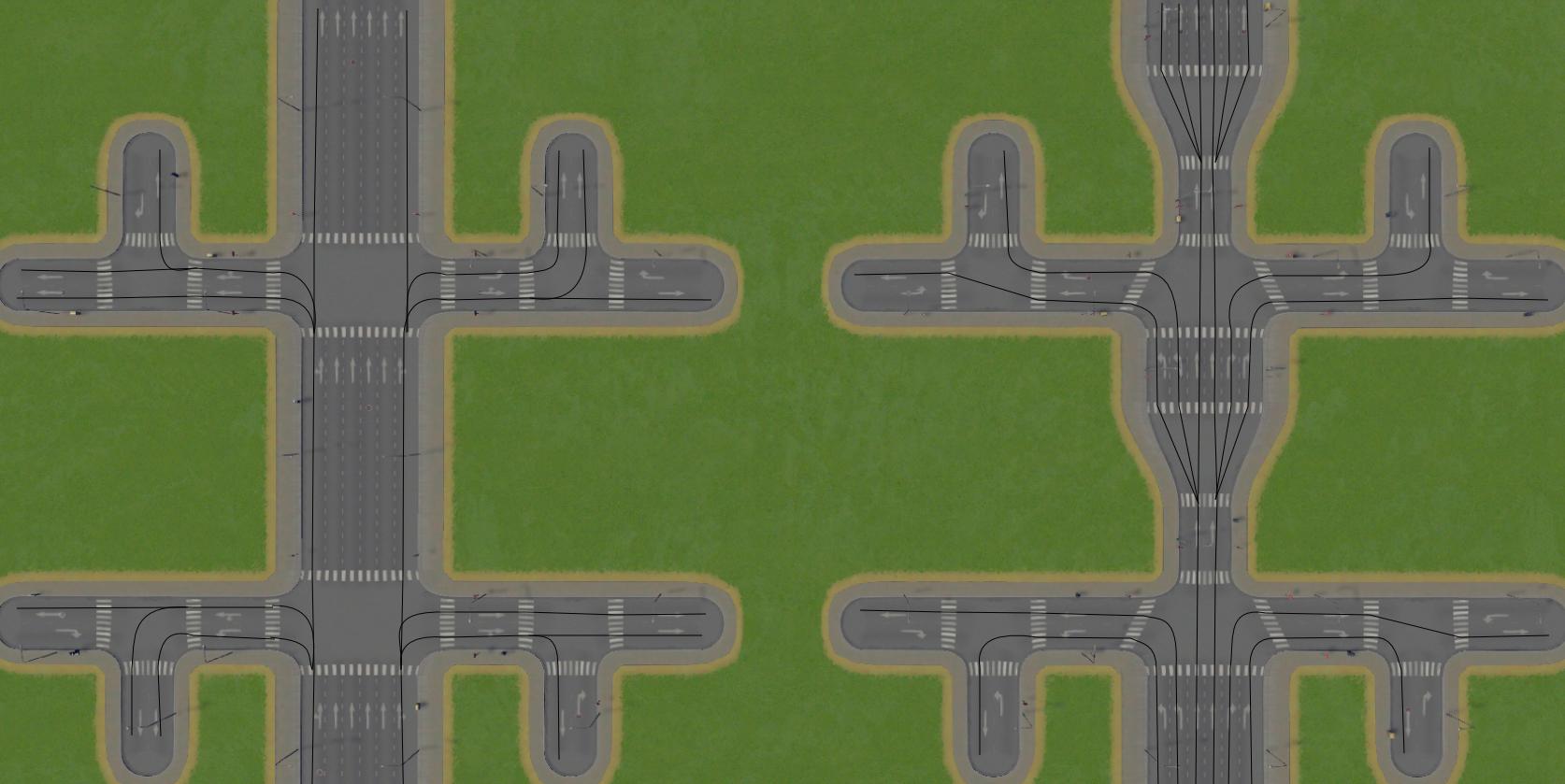
For example if you have a 6-lane, one-way, road with intersections cars will get into the right/left lanes as soon as they get on the road, even if that's on the other side of the map from where they're turning. Causing the middle lanes to become useless and the others to be backed up (admittedly this isn't totally unrealistic though). I remember Sim City had similar problems and I'm sure it's a tough one to solve. Especially on a big game world with hundreds, or thousands, of intersections and tens of thousands of cars being simulated at once. Even if they don't solve it I'll still be burning my weekends on this game for a long time.