I'm thankful that women + video games is an issue that is continuing to get talked about - with a young daughter I hope that introducing her to one of my pastimes will be something that we can enjoy together. Games like Broken Age and Animal Crossing seem to have done well on that front.
One small criticism for this article - personally, I feel that these kinds of articles tend to conflate two issues: 1.) Women working in the video game field (or STEM in general), and 2.) Video games intended for a female audience.
Both are very important, but speaking about them together may give the impression that forward progress on one is required for the other. There is little reason that an industry largely populated by men cannot make content that is suitable for women. Conversely, when we reach gender equality in the gaming industry, we should not assume that gender-equal content will follow.
Generally, I'd love to see less of the "made for girls = everything pink" approach. I guess it probably keeps the lights on, which is better than nothing. The gaming industry's trajectory is promising though.
This is a personal question, since my values are going to differ from yours that will differ from the rest of the world.
I welcome games that treat gender as a non-issue. What I do mind are games that treat gender as some sort of precondition on body image or societal roles.
In this day and age there's enough choice and content out there that I can manufacture a gender balance for my kids that I feel comfortable with. Sometimes there are gotchas - games (or movies/TV) that seem ok but have small portions I don't agree with, but these are bumps that I can smooth out myself. It's just that sometimes I'd rather it not occur at all.
Again, I think this is deeply personal. I may think a certain game is perfectly fine for my kids, and another parent may recoil in horror at the suggestion (and vice versa).
At the end of the day, I enjoy playing video games, and if there are more games that I think are appropriate for my kids, the easier it is for me to enjoy my hobby with them.
Unfortunately, and ironically, the author of this article is laboring under a misconception as to why "video game critics" ought to feel embarrassed.
"Game journalists" are a notoriously corrupt and incestuous group who are currently cynically propping up "gender diversity in games" as an issue to use as a cudgel in order to generate more pageviews for their work and to further their own careers. The recent Zoe Quinn debacle is a perfect illustration of this dynamic.
There are a number of specific problems with this article, to name a few: an undercurrent of hatred of masculinity and men, and a persistent association between them and negative traits such as violence ("non-phallic FPS", wtf?), mentioning his personal interest in the issue because he has a daughter as though that would bolster his argument rather than undermine it, and some gender revisionism with regard to the creator of M.U.L.E. (which one may object to on purely philosophical grounds). To list them all, however would involve more text than was present in TFA.
If anyone needs to "do better" regarding gender representation, then surely it is not the people who make hiring decisions (who already add bias to favor women over men), but the people who write about these issues in such lazy, thought stifling, and intellectually dishonest ways.
All else aside, do "secretary pools" even still exist? At the very least I've never come across any at any of the companies I've worked for. I am near certain they do not exist at my current company; I've interacted with "executive support teams" (not called that, each individual on those 'teams' has their own job title and role) on several occasions and none were what I would call a "secretary pool".
> All else aside, do "secretary pools" even still exist?
Mostly, pools of clerical support staff have been both subject to reduced demand and outsourcing so that capacity is provided at-need from temporary/staffing services (though I've encountered some places -- specifically universities -- that have their own temporary employment pools that include, but are not limited to, clerical staff.)
I have first hand experience of sexism levelled at various female colleagues and students of mine in computer science academia. I don't feel the particular urge to write out their stories in depth here, as you can find such stories everywhere, but they certainly occur
Repeatedly verified statistics from good samples gathered as a result of experiments with controls.
>I have first hand experience of sexism levelled at various female colleagues and students of mine in computer science academia.
There is a tendency for certain personality types to lump every petty slight and personal disappointment together under "sexism", without any sort of critical reflection. The original question requiring evidence was regarding hiring discrimination in game studios. I am not aware of any game studio which even has a "secretary pool".
> I am not aware of any game studio which even has a "secretary pool".
There doesn't have to be an actual secretary pool available for a manager to make a dismissive comment to a female engineering applicant that that's where they should instead be applying.
Just like Hell doesn't need to exist -- either in reality or even in the speaker's belief -- for someone to dismiss someone with "go to Hell".
> Repeatedly verified statistics from good samples gathered as a result of experiments with controls.
Many parts of sexism are day-to-day personal interactions, those kind of things are hard to measure.
> There is a tendency for certain personality types to lump every petty slight and personal disappointment together under "sexism", without any sort of critical reflection.
I'm going to need some repeatedly verified statistics from good samples gathered as a result of experiments with controls for that claim.
"I just said she had nice tits. How is that sexism?"
I'm sure that's just a "petty slight" and "personal disappointment."
Sexism comes in many flavours, from overt to thousands of little attacks that don't stop coming. Sometimes you just need to put things in perspective: https://www.youtube.com/watch?v=V4UWxlVvT1A
I noticed the comment about M.U.L.E. as well, that was a masterstroke of Stalinist revisionism. I can't help but wonder about the timing of the article either, but I'm happy to evaluate it on its own merits. Recognition of women in the history of gaming is a welcome topic even without hidden agendas and I'm happy to read them, though I would have preferred more substance than this one. Is Roberta Williams underappreciated? She is pretty famous, but I don't think she's famous enough for the influence she has exerted on video games. (As a side note, consider editing your comment to remove references to The One Who Must Not Be Named.)
surely it is not the people who make hiring decisions (who already add bias to favor women over men)
That's not true, though. As much as people like to shout about political correctness gone mad, I'm yet to see any actual evidence of a bias towards women in hiring.
But then, I am debating this with someone who has the username 'pervycreeper', so I'm not entirely sure if I'm being trolled or not.
> The main challenge comes when we actually do get a female candidate. We don’t discard a single one on resume. We see all of them. We discard about 80% of guys on resume. But even so, we get to see 4 guys to 1 girl or so. In the interviews, we help the girls shine, because we actually want to hire them, but then, one of the other 4 guys shows just an amazing performance, for whatever reason, truly impressive, like he has done many more things than the girl (and than the other candidates), can show more amazing code, personal projects, etc. And we think: “If the girl was a guy, she would not be on the race with this guy, just like the other male candidates are totally discarded now”. Should we let this amazing coding guy go? It’s not easy to find amazing coders either, you know?
And it makes sense that someone would vent such things anonymously or not at all, considering the skewering they'd get from the media if they even suggested anything of the sort publicly.
As someone who's experienced teaching programming classes for girls, I can wholeheartedly say that trying to recruit candidates who are actually interested in the area is quite difficult. The program I worked for eventually had to move away from being a 'programming' course, to more of a 'digital arts' course just so that we'd get enough applicants to justify continuing it. And this is in the bay area, the tech/liberal capital of the country. So I can totally see this happening in the workplace too.
>I'm yet to see any actual evidence of a bias towards women in hiring.
Anecdotes aside, it is the official policy of most companies, usually under the Orwellian title "non-discrimination policy" or "diversity policy" or some such. This is before we factor in any personal crusades that the hiring officers may or may not be engaging in.
Something I always wonder when topics like this come up, maybe someone has some industry data to illuminate me. According to the article, "22 percent of the people who make video games are women." What I wonder is, for a given open position at a video game company, what percentage of the people who apply are women? My gut tells me that it's probably substantially less than 22%.
That's not to say that there isn't a problem or that women don't want to work in video games, but I feel like the blame for there not being more women (or more appreciation for women) in the games industry lays heavily on the studios. I think seeing the ratios of applicants vs the ratios of hires would be an interesting way to see how the industry actually feels about women.
Even if your gut was a valid source of data, the proportion of applications is a bad metric - you need the proportion of applications from strong candidates. Women applying for jobs in a field where there is a perception of sexism might be deterred from applying in the first place, especially if they feel they don't have the skills to outshine the men who apply; men may be more likely to apply even if their skills are only marginal for the role, because the industry has given them a disproportionate confidence in their abilities. So you might see a 16% female application rate, yet have women make up 30% of competent candidates, but still wind up at 22% women hired, which would not be the evidence of positive discrimination you suggest at all.
The way sexism in hiring decisions works is subtle. Development is a team sport. When a candidate comes to you and tells you 'I worked on this highly respected game,' you are impressed, but need to try to figure out what their contribution was to the team. Did they solve the really hard shader engineering challenges that gave that game its unique look while maintaining 60fps? Did they just do a bit of coding on the menu system? Did they do nothing but make the coffee? So you ask, but your prejudices color how you hear the response. If you tend to assume that girls just don't do quaternions and stuff, you hear 'I worked on the water simulation' and if it's a guy you assume they did a bunch of stuff with physics and navier stokes equations, but if it's a woman you interpret it as 'I made the sparkly bits when things go splash'. If you're gender-blind you allow the possibility that the person in front of you might fall into either of those camps regardless of their gender.
And it goes beyond hiring, into work assignments. You've got two pieces of work that need to be done: one is going to involve hard math, the other is building tools to help the testers QA stuff. Unconsciously, you let your prejudices about gender roles play in and assign the math work to a male coder and the tool to a female coder. Subtly, you push the women to less prestigious roles that limit their career options, while giving men opportunities to advance theirs.
And then when your studio goes belly-up and those two coders are applying for work elsewhere, which one has the more impressive resume and is able to get in the door somewhere else?
"Surprisingly, there is no good resource, online or off, that compiles the work that women have done to influence the history of video games. Uncovering who did what and when can be a challenge in a secretive industry ruled by marketing teams and nondisclosure agreements."
Check the credits? Hiding game developers has been a thing since the NES revolution AFAIK. I don't know that anyone's made great strides towards documenting the history of video games in general.
Still not really sure what to make of the "phallic first-person shooter" comment.
Because it's a poorly written article and the media on this issue is in a really silly place right now, but no one sane wants to deal with the hysteria currently associated with mentioning a burger chain so it's hard to construct well-reasoned yet diplomatic criticism.
I want to take a moment to talk about a woman in video games. She made a really great game, well some people don't call them games, but it was a text adventure game. A quite well made one. Many people didn't realize how effectively you could leverage the medium to make such an emotionally evocative piece of, dare I say it, art.
I am of course talking about Emily Short. In the year 2000 or thereabouts, she made a short interactive fiction story called "Galatea." ( https://en.wikipedia.org/wiki/Galatea_%28video_game%29 ) I highly suggest trying it out.
I think it's sad how fourteen years later, similar to the devolution of FPS's from Quake to Call of Duty, some new text adventures may have gained a much wider audience and are praised to high heaven but are clearly inferior artistically and in design.
Emily Short is a truly great game author, theorist, designer, and contributor to Inform7! She has won several awards for her work. I hope no one thinks of her as "forgotten".
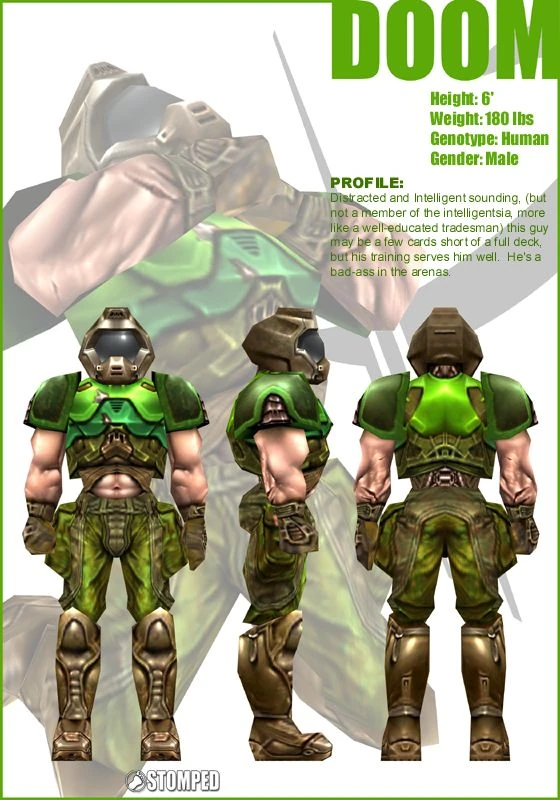
I don't know what he means, but I can give my own perspective (primarily ex-gamer, used to play a lot of Q3A, Doom, and similar):
FPS games used to have very simple orthogonal game mechanics. Large amounts of complexity would arise from those small lists of simple game mechanics. A 'board game equivalent' to this concept might be Go (or if we are being less flattering to the video game industry, Draughts/Checkers). This orthogonality was best showcased in weapon design; you'd often have less than 10 guns, which each behaved in completely different ways and were best used in completely different situations.
  Q3A examples:
    gauntlet: the only melee weapon
    machine gun: hitscan, accurate, fast rate of fire, low damage.
                 typically available on spawn.
    shotgun: hitscan, inaccurate, slow rate of fire, large damage when close.
             must be picked up.
    railgun: hitscan, accurate, slow rate of fire, devastating damage.
             must be picked up.
    lightning gun: not-quite-hitscan beam, medium-short range, high damage.
                   must be picked up.
    etc...
Modern games, typically aiming for some perverse sense of "realism", typically lack this sort of weapon orthogonality. You get typically get the basic categories of "assault rifle", "sniper rifle", "handgun", "submachine gun", and "something that shoots explosives", which is all fine and good, except each of those categories has half a dozen or more variations that have very boring differences. Like 6 pistols that only differ in clip size or damage (with one or two clearly being the dominant weapons in all situations). For a concrete example of a game that I think suffers from this: Watch_Dogs. 10 different handguns, but the only one that it ever makes sense to use is the handgun that you start the game with (accurate, silenced, and semi-automatic. yeah there are the automatic handguns, but why would you use them when you could just use one of the automatic rifles? The game gives you absolutely no reason to care about the other handguns).
That's just weapons. I have observed similar trends across nearly all other game mechanics in modern shooters. It is like game developers forgot how to create complexity from a small list of simple mechanics and instead just pack games full of shallow features.
When you play or watch a game, try the following: Imagine that all the models and textures were swapped out with generic low-poly abstract placeholders. All handguns are small thin blue boxes, rifles are all long thin teal boxes, etc. Does the game still play well? If it is Quake or Doom, then the game plays exactly the same as it did before. If it is a modern game, then chances are several pointless redundancies become obvious and several previously "neat" game mechanics become obviously shallow. They have several "different" game mechanics that are different from each other only in the model, texture, or animation used.
Mario-Party-esque "Push X to perform [every damn action in the game]" stuff is another biggie for me. Incredibly lazy stuff which apparently appeals to modern gamers.
Yup. I know exactly what he means, but we don't have to explicitly say it and open that whole can of worms. I think it's best to grab some popcorn and watch from the sidelines, not actively participate in the silliness.
How is someone writing an article about a very little discussed topic, compared to the huge number of articles and books about make game developers, stifling?
You have it the other way around. Tomp is saying that indiscriminately shutting down any criticism of this topic is having a chilling effect on discourse.
I agree. Can you imagine anyone daring to post a negative opinion about this article? They'd be verbally assaulted, down voted and shadow-banned in minutes.
I wasn't talking about the article being stifling, rather the discussion (as witnessed by the downvotes). Can you list some of the articles/books about specifically male game developers? I haven't seen any yet (though I must admit that I rarely read anything about gaming, except technically oriented articles).
There are huge numbers of articles and books which exclusively discuss male game developers, almost every one I've ever read.
Did any of them say "This article will only be about men"? No. I'm not clear of your point -- do you wish all articles which only discuss men were labelled as such?
My point exactly; there are no articles saying "this article will only be about men" like this one is about women. Instead, they are saying "this article will be about great games" or "shitty games" or such. That's why I perceive this article as sexist.
That's because you're using a term you don't fully understand. Singling out men and women for gender-neutral praise ("great women in video games" or "great women in badminton" or whatever) isn't sexist.
"Sexist" is a normative term. It describes an "ought". Specifically: sexism points out instances where we "ought not" stereotype genders. So it would be sexist to point out that women as a class are inferior or superior at video game development. This post does neither of these things.
The term you're flailing around for is "gender biased". "Gender bias" is a descriptive term. It describes an "is". This post "is" about highlighting the achievements of women in the industry. It uses gender as a criteria for inclusion.
By itself, gender bias leaves you with too many unknowns to solve the system for a normative result. You can add intent and circumstances (for instance) to solve it for impact. If you think the intent of this article is to suggest that women are superior to men, you'll sound like a crazy person. If you suggest that the circumstances of gender balance in our industry are such that women's achievements are nonnotable, you'll sound like your head is in the sand. But you haven't even done either of those two things; you've got x, y, and z, one equation, and have just decided to leave y and z out and declare the system solved.
One example of this I've used in the past is a maternity ward. This is very clearly a health facility with a high level of gender bias. It is not sexist in the least though.
I haven't figured out a good example of something that is sexist that doesn't display gender bias though...
> Singling out men and women for gender-neutral praise isn't sexist.
I agree. However, this isn't a Wikipedia article (which should usually be accompanied by a similar article about the opposite sex). And this article has some issues (IMO) that a Wikipedia article wouldn't have; I won't list them, as I said in my first comment, but @pervycreeper list some of the issues he sees.
> The term you're flailing around for is "gender biased".
Possibly. However, in my mind "sexism" (along with every other "-ism") is defined as any (irrelevant) discrimination, including positive discrimination. Therefore, I perceive the current "more women in CS" craze (nor the general "more people in CS" trend) as inappropriate/(unfairly) biased/-ism. Of course, we might argue whether it's irrelevant or not; personally, I was brought up in a different society where everyone had to work, my mother was the technical person in the family, and if anything, I was discouraged from spending too much time behind the computer, so I'm convinced that in my country, in my generation, computer skills are the result of means (computers were much more expensive back then) and interest, and not gender at all; if I were brought up in the US, I might have a different view on sexism in CS.
Well, what's in your mind is interesting, I guess, but it has nothing to do with how the world works.
The reality is: people who talk about "reverse sexism" like this are, almost as a rule, trying to minimize discussion of sexism against women. I'm now discriminating against you based on that statement, but it's OK, because that discrimination isn't irrelevant: there's a search bar at the bottom of the page, and it's really easy to use it to see where you stand on this issue.
> but it has nothing to do with how the world works.
Possibly. But as they say, "be the change you want to see in the world".
> people who talk about "reverse sexism" like this are, almost as a rule, trying to minimize discussion of sexism against women
Well, there is sexism and there is "sexism". If we're talking about things like forced marriage (more specifically, older men marrying underage women), FGM, human trafficking/sex tourism, violent rape, etc., I'm all for it. Of course, these topics are rarely discussed, because there is no discussion necessary - pretty much all people agree that they are awful, and that they should be solved.
On the other hand, if we're talking about things like GitHub's meritocracy rug, "the patriarchy", that the female CEOs are paid less than male CEOs, that there should be more women/people in CS, or domestic violence against women, then I'll be pointing out a few things; (1) these topics are not really deserving of the attention they're getting (poor millionaire CEOs; why don't we talk about the homeless people instead), (2) they are sexist (why not talk about domestic violence in general - recent studies suggest that there is a huge number of male victims as well, and no support systems for them), (3) they often have a hidden agenda (noone wanted to be a programmer before geeks became cool and started earning a lot of money). IMO, these are all very valid arguments, but because they are comments about sensitive topics, they get downvoted.
If an article doesn't say it will only be about men, but is then only about men, is it sexist? (I don't really have a firm result here, certainly some articles just happen to be about men, and others which should mention men).
Depends on what's in it; an article about Nobel laureates that doesn't mention Marie Curie, or an article about the history of CS that doesn't mention Lovelace, Hopper or Liskov probably is. However, if history in a particular subject was made mostly by men, it's totally appropriate for an article about that history to mention only men. I don't know enough about history of gaming to judge this article on that merit (personally, I would only list 3 notable games programmers: Newell, Sweeney, Carmack, and a dozen or so games).
Too bad. You didn't give us a chance to see and possibly learn your viewpoint and missed a chance yourself from getting your ideas analyzed by a critical crowd. Being a contrarian is not a bad thing.
If you haven't already done so, I suggest you read "What You Can't Say" by pg (http://www.paulgraham.com/say.html) and Letters to a Young Contrarian by Christopher Hitchens.
Way to take a quote out of context (literally cutting off part of a word). Here's the surrounding sentence:
"Some of the most original games in recent years have been made by women. Kim Swift was the lead designer for Portal, which one game critic called the first nonphallic first-person shooter."
Oh look, the full quote is appreciating a female game pioneer, and your mangled phrase was from a singular game critic. Also, it makes sense. Instead of shooting bullets, you're shooting portals. Seems pretty non-phallic to me.
> Instead of shooting bullets, you're shooting portals. Seems pretty non-phallic to me.
What's phallic about bullets?
Are women not allowed to be interested in small arms? The Soviet Union deployed women as snipers to great effect in World War II, and the idea that only men could be violent and warlike is itself gender-biased to those who look at history.
I can't tell if you're serious. Do you really not see the distinction between bullets and portals in a phallic vs, non-phallic context? You are literally shooting phallus-shaped objects with the intent to penetrate your target. On the other hand, you are shooting oval openings into which things enter.
This isn't very complicated or contentious from any angle I can imagine. Unless you're coming in with an agenda, and take offense to the idea that certain types of games might be traditionally male-oriented.
> "On the other hand, you are shooting weird milky looking things out of a phallic object, then thrusting your player into a rather vaginal opening."
If bullets are "phallic" (despite rarely even having in-game models) then portals are "vaginal" and the primary game mechanic is to have your player "penetrate" them.
In reality, all of this is just pseudo-intellectual Freudian bullshit.
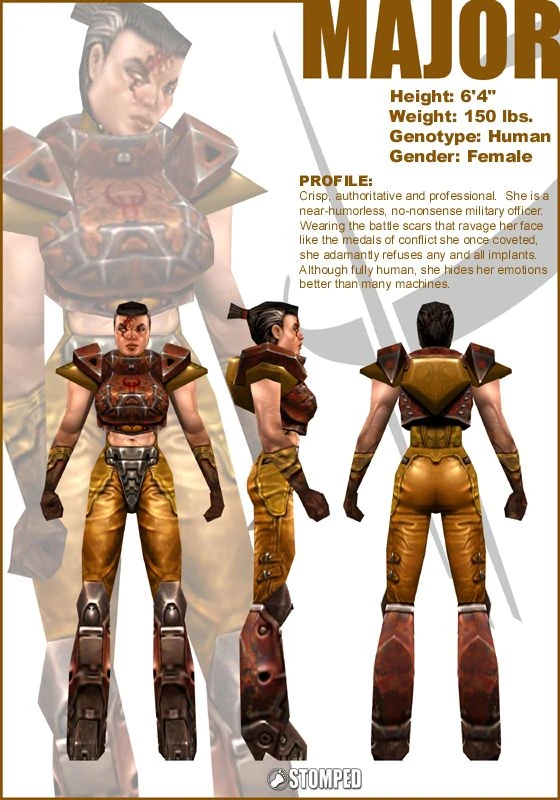
The phrase isn't wrong, though. The vast majority of FPSes involve you playing a man, shooting other men. Sometimes it'll include a woman, but only if she's very, very scantily clad.
Reducing men to the physical expression of their sex is more sexist than anything else mentioned in the article. I will grant you "masculine," "macho," or even "puerile," but "phallic" is simply offensive.



One small criticism for this article - personally, I feel that these kinds of articles tend to conflate two issues: 1.) Women working in the video game field (or STEM in general), and 2.) Video games intended for a female audience.
Both are very important, but speaking about them together may give the impression that forward progress on one is required for the other. There is little reason that an industry largely populated by men cannot make content that is suitable for women. Conversely, when we reach gender equality in the gaming industry, we should not assume that gender-equal content will follow.
Generally, I'd love to see less of the "made for girls = everything pink" approach. I guess it probably keeps the lights on, which is better than nothing. The gaming industry's trajectory is promising though.