One key point that is missed in this article: why do people making minimum wage have trouble making ends meet? Because all this advance of technology has not made the necessities of life cheaper in the same way it's made, say, computers cheaper. For a few hundred dollars today, you can buy orders of magnitude more computing power than existed in the entire world when I was a child. Yet it's still difficult for people working low wage jobs to afford food, housing (meaning housing in an area that's reasonably safe to live in), and transportation (again, that's reasonably safe to use).
Why is that? Why has all this enormous improvement in productivity not made the necessities of life so cheap that even someone making minimum wage can easily afford them? It seems to me that fixing that would go a long way towards fixing the problems Altman is talking about, yet nobody talks about it.
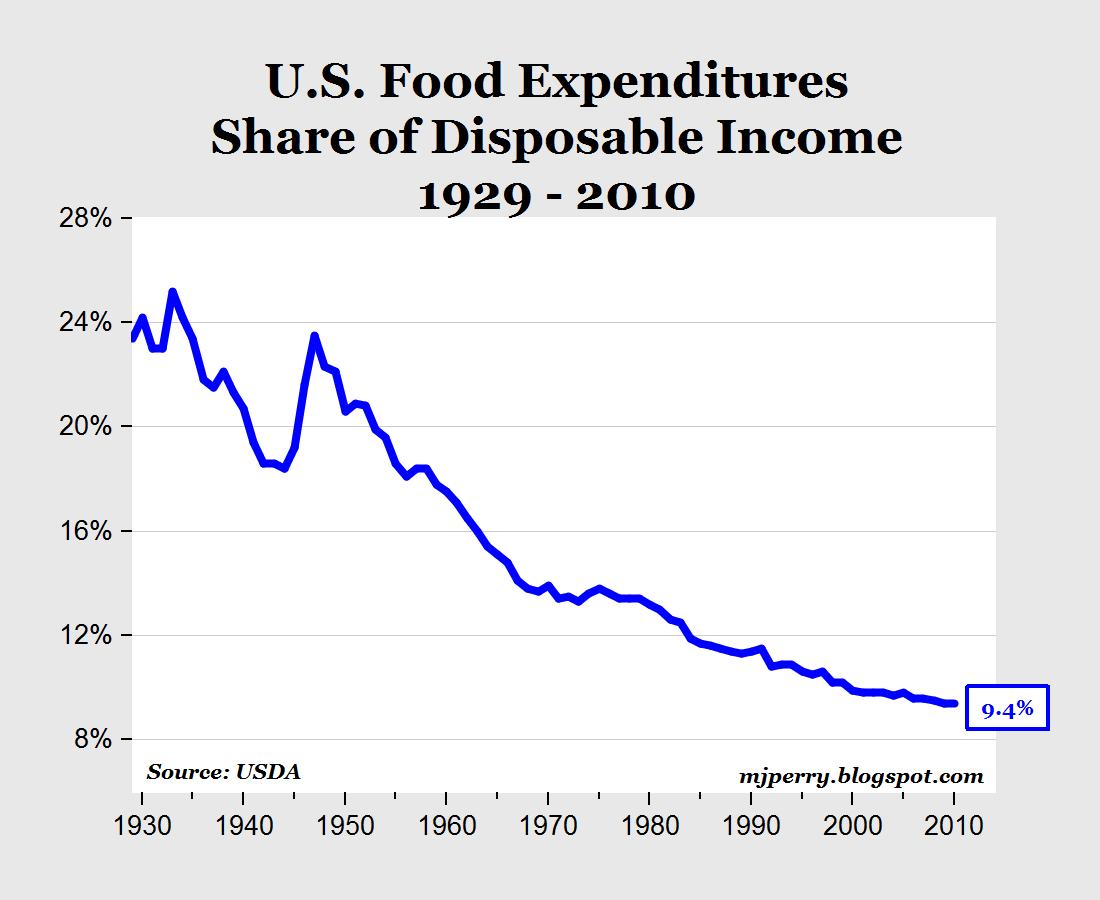
Do you agree with the statement "Food is at least as expensive in America in 2014 as it was in 1974"? If so I have some really great news for you, but I don't want to put words in your mouth.
Do you agree with the statement "Food is at least as expensive in America in 2014 as it was in 1974"?
No; that wasn't the point I was making. The point I was making was that, as a responder to you noted, food has not fallen in price the way other things like electronics have. Granted, there isn't a Moore's Law for food the way there is for computers, as someone noted downthread; but still, it doesn't seem like food has fallen in price as much as it should have given the increases in productivity that have taken place. I think a key reason for this is that the government messes with food prices in ways that it does not mess with prices in other sectors of the economy.
But another point that could be made is that, if food has fallen significantly in price (which, as several posters now have quoted numbers to show, it has), why do we still hear so much about people having trouble making ends meet at the low end of the income scale? In other words, is the problem Altman is talking about a real problem, or just a perceived problem?
Do you agree with the statement "For a few hundred dollars today, you can buy orders of magnitude more [food] than existed in the entire world [in 1974]"?
I kid, of course - and I'm actually interested in hearing the parent poster's response - but clearly food hasn't fallen in the same way that electronics have.
Correct, see http://www.fas.org/sgp/crs/misc/R40545.pdf . You'll note that even for the lowest quintile this is a decline of over 50%. It would be higher if you just looked at constant consumption, but we don't do that, because our societal consensus is that poor Americans in 2014 do and should treat as standard what Americans in 1960 treated as luxury, including most relevantly, having other people cook for them.
This is because, and I know this statement is controversial, America is radically wealthier at all levels in 2014 compared to 1974.
Partially because real wages for people making minimum wage are down (I touched on some of the reasons why in the post). It's worse in concentrated rich areas like San Francisco.
However, I do think costs have come down in a lot of areas.
One reason is that as technology improves, the value of a person's time ("productivity") also increases. Thus although manufactured goods get cheaper, services get more expensive (due to opportunity cost).
Most of the day to day innovations you use are owned by minimum wage earners. Cellular phones, TVs, cars and internet are nearly ubiquitous items.
It's not that innovation did not reach the needy, it's just that there are some problems that are outside the influence of technology. For example, making neighborhoods safer or promoting better family planning.
Aren't unsafe neighborhoods so because of, first and foremost, their inhabitants?
Aren't unsafe neighborhoods so because of, first and foremost, their inhabitants?
Because of some inhabitants, yes. But there have always been a small percentage of people that are going to try to prey on others. Whether or not they succeed depends on how the rest of society deals with such activities--not just the people living in the same neighborhood, but society as a whole.
I think the answer is more or less that transportation costs aren't going down. We produce more than enough food to feed the entire world population, but the poor can't afford to buy it because of the cost of transporting it to them.
This doesn't seem right to me. Transportation costs are negligible for all sorts of products. It costs more in gasoline for you to drive to your local Best Buy and bring home a DVD player than it does to ship that DVD player from the factory in East Asia somewhere halfway across the planet to the store. Huge economies of scale have been realized in transportation.
If, on the other hand, we include under "transportation costs" the costs of dealing with corrupt governments in many countries who enrich themselves at the expense of their people, then yes, there are significant transportation costs in getting food to poor people in many countries.
> Yet it's still difficult for people working low wage jobs to afford food, housing (meaning housing in an area that's reasonably safe to live in), and transportation (again, that's reasonably safe to use).
I think one thing ties these together (as a common denominator): land. There's a limited supply of land in any city/county/state/country/planet, so people must compete for it. Agriculture also requires land, and you can't even scale it vertically as well as you can scale housing (you may build taller buildings, but not taller farms).
Yes, there's a finite supply of land, but much of it is not currently being used for either housing (or more generally, housing, offices, factories, and all the infrastructure that goes with them, such as roads) or agriculture. In fact, IIRC, the fraction of land on the Earth that is used for all such purposes has been decreasing in recent years.
On a related note, I found this online game to be somewhat enlightening in terms of pointing out various costs and difficulties faced by those at the bottom end of the socioeconomic scale:
It probably has to do with how some technologies scale. For example, processing power advances exponentially with time (see Moore's law). Few other things do. The things you would consider a "necessity of life" have scaled linearly, if at all.
Food production has certainly advanced with GM crops that are resistant to insects, droughts, etc. and produce more edible material per acre, but not that much more. Fertilizers and insecticides have also improved yields, but just a bit. Farm machinery has advanced tremendously but, as discussed in the article, it lets fewer farmers work more land rather than making the land itself more productive. Food is still pretty expensive to produce. Most nations do produce more food than they can consume though, even some that experience famine. Distribution is still a big problem and a huge part of the cost of food.
The average person now has access to a huge variety of foods from distant places. Transporting food costs a tremendous amount, both in terms of money and environmental impact. This is why you often hear about local foods being better for the environment. However, a rather large portion of the world's population has only seasonal access to locally produced fresh produce, which we now consider necessity for good health. If, like a large portion of the world's population, you live in a place where fresh produce is seasonal, consider what your diet would have looked like before canning came along. Technology has performed wonders for the average person's winter diet!
Of course, technology has a funny way of turning on itself. The triumph of spinach, oranges, and bananas in January has been followed by potato chips and cola. We turned food from a necessity into an addiction. Brilliant minds toil away in corporate labs, trying to find some new way to increase the "mouth share" of their product lines. The goal is not to satiate, but to arouse never-ending hunger for your product!
One simple, practical thing that could be done would be to rework farm subsidies. Corn is one of the most heavily subsidized crops in the U.S.. Corn farmers are paid well to produce a crop that has often not been in demand. One root of the anti-globalization movement is the Zapatista revolt in Mexico, which was, in part, sparked by NAFTA flooding the Mexican market with super-cheap subsidized Iowa corn and putting marginal, non-mechanized unsubsidized corn-farmers out of business en masse. Domestically, it's not a huge surprise that high-fructose corn-syrup found its way into most processed foods. High-fructose corn syrup is cheap because corn is cheap, and corn is cheap because our taxes pay farmers to grow it. If you look at the other top subsidized crops in the U.S., you'll not a common theme. After feed-crops (mostly corn), there's cotton, wheat, rice, soy, dairy, peanuts, sugar, wool tobacco[1]... It's mostly high-calorie crops rather than high-nutrient. How Tobacco snuck in there, I have no idea.
Why not change subsidies to be aware of crop destination and emphasize dietary health? Slap a big-ol subsidy on spinach and broccoli sold fresh to market and obliterate the subsidy on corn used for high-fructose corn-syrup. Healthy foods get cheaper, unhealthy foods get more expensive.
> Food is dirt cheap compared to housing, especially if you shop smart.
Don't be ridiculous. Have you ever tried to buy food on a minimum wage budget? If you want to eat anything that has even a modicum of nutritional value, minimum wage won't get you much.
I'm not suggesting that expensive/organic food is worth it's price. Nor am I suggesting that minimum wage should be raised to the point where everyone could afford to shop at Whole Foods. But if you honestly believe that the author is wrong when he writes "it's still difficult for people working low wage jobs to afford food", then you need a reality check.
If you want to eat anything that has even a modicum of nutritional value, minimum wage won't get you much.
Sure it will; it just won't get you much in the way of enjoyable food. People mostly don't like living on beans and lentils; but you can get sufficient essential nutrients from unappetizing foods like that for a few dollars a day.
Please note that I am not saying anyone should have to live on beans and lentils; I'd be no good at it myself. But we should be clear that the problem is not "getting enough to eat"; the problem is "getting enough to eat with some kind of decent quality of life".
I've lived almost my entire adult life on a minimum wage budget (and/or close to it).
I think it really depends a lot on where you live. I live in NYC now, and fruits and vegetables here are about 75% cheaper than when I lived in the midwest. I can get a pound of blackberries for $2, when I'd pay probably double that for just a few ounces of them in my home state. Takeout is almost as cheap as cooking (filling, tasty meal for $4-5), which helps drives down costs when you're exhausted and don't have any more energy left to make something.
If you want cheap, healthy food, try shopping in some of ethnic stores in lower income neighborhoods. That's what I do. I can walk out of the local Asian grocery store with enough food for 2 for a week and it costs me about $50. It's mostly vegetables.


Why is that? Why has all this enormous improvement in productivity not made the necessities of life so cheap that even someone making minimum wage can easily afford them? It seems to me that fixing that would go a long way towards fixing the problems Altman is talking about, yet nobody talks about it.