I can't stress enough how damaging the drug war has been to our justice system. It's not only unfair to the (mostly poor minorities) that get caught up in the war, but is unfair to everyone else that receives slower service from the federal court system as a result of dockets clogged with drug cases.
That said, the lede of the article is dumb. The article complains about the drug war and plea bargaining, but Ronald Thompson's plight is not the result of those things, but rather of an overzealous gun control law: http://en.wikipedia.org/wiki/10-20-Life. Under this Florida law, the fact that Thompson fired a gun during what was otherwise a felony assault resulted in a mandatory 20 year sentence.
Indeed, the fact that many people who would otherwise oppose the drug war support gun control laws like this shows a deeper problem with American society than just the drug war. Whether we're calling for longer prison sentences for bankers or people convicted of gun crimes, we just love putting people in prison.
I think this is happening because of a general perception that too many people are "getting away" with breaking the law. It doesn't seem to matter that we're criminalizing everyday life and that many of the folks who actually deserve these penalties are untouchable due to money or politics, the sense of injustice is enough to make you want to just clamp down on everything. This means that for the few people that can exercise influence over the police and judicial system, the upside (votes, funding, whatever) from damaging it further far outweighs the miniscule chance that they themselves will get caught up in its workings.
It seems like it's caught in a death spiral. And it bothers me tremendously that, as a decent guy, I'm actively afraid of our judicial system.
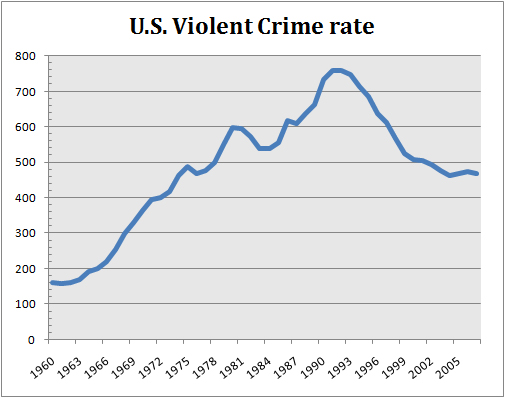
There's no reason to turn everything into some "untouchable due to money or politics" angle. There is a simple reason why people perceive that harsh response to crime is necessary: http://www.volokh.com/wp-content/uploads/2013/01/vcrime500.j.... The violent crime rate in the U.S. peaked in the early 1990's at about five times the per capita rate in 1960. Florida's law was passed in 1997 or so.
I'd agree that that "untouchable" idea is perhaps too easy to reach for, but I really do think it's germane to this particular problem. You seem to be well-informed on the subject, perhaps you could comment on this:
It seems to me that for a reasonably well-off person, being incorrectly or even maliciously accused of [random crime] may be inconvenient but you can probably throw comparatively small amounts of money at it until it goes away in the natural course of things (unless you're particularly unlucky). For a regular wage-earner with minimal savings, that same scenario can be a nightmare of missed time at work and incompetent or uninterested representation. If there's any truth to the accusation, the first case probably ends worse for the subject and the second case ends catastrophically.
This, in my mind, speaks directly to why even well-meaning lawmakers would be willing to contribute to the systemic damage that's been happening: their "sense" of how the legal system works is strongly skewed by the experiences they and their friends and family have had. I've had friends in both situations and the contrast was really stark.
On the massive increase in violent crime 1960-199x, wasn't that actually heavily localized in urban areas? We moved near Oakland, CA in the early 90's and it was completely unlike the various areas we had lived in previously. Though I suppose that wouldn't change the effect it had on general perceptions, with broadcast and then cable news delivering the worst of the nation every night.
Every negative impact that the post 9/11 terrorism scare has had on America has been inflicted 10 or 100 times over for decades due to the war on drugs. Even with all the horrible NSA revelations it still remains the biggest threat to liberty and uncorrupted rule of law in the western world.
I do not know the historical details of this Florida law, but gun control laws are generally a way to get votes from blacks who are afraid of drug gangs. (It is an exercise for the reader to figure out which demographic group bears the brunt of this law.)
I thought this was an interesting article, but the following jumped out at me:
>Ronald Thompson’s case, and so many others, reveals that prosecutors don’t think that twenty-year sentences for shooting into the ground constitute justice. Why else would the plea bargain stay on the table.
The reason (in a majority of cases) plea bargains stay on the table is not because the prosecutors don't think the mandatory minimums constitute justice, rather the prosecutors do not have an incentive or otherwise want to go to trial. Therefore, they dangle the carrot and stick in front of the defendant (e.g. in this case, take 3 years or roll the dice and if convicted serve the minimum 20). So why don't prosecutors want to go to trial? Because the have extremely large case loads, they could not possibly take them all to trial, but to even take one to trial requires exponentially more work than getting the defendant to accept a plea. Additionally, if a prosecutor does all the extra work required with going to trial (win or lose) they do not get paid for all the extra work.
And they have extremely large case loads because Congress creates over 60 new federal crimes every year, and because the same prosecutors prosecute thousands of acts that harm nobody and should not be prosecuted. If they were made to actually work for prosecuting them, then maybe they would wake up to the reality of over-criminalization and asked for a reform. However, if they can just make a conveyor belt type system where they just can quickly extort plea bargains and move on, of course no problem for them.
I miscalculated the average a bit: it's 56.5 per year, not 60 (I thought it is 7 year period but it was 8 years).
The growth of federal crimes continues unabated. The increase of 452 over the eight-year period between 2000 and 2007 averages 56.5 crimes per year-roughly the same rate at which Congress created new crimes in the 1980s and 1990s.
I gather that in some legal systems, the German system for example, mandatory prosecution of every crime is required because of this problem.
It seems worthwhile to ask what a good incentive for prosecutors would look like. For example, an incentive that rewards winning a trial more strongly than excepting a plea.
From friends in state prosecutors offices in a couple of states, I understand that there is a professional incentive to try cases on a fairly regular basis. Even though the office as a whole benefits from plea bargains, it's trial work that is apparently most respected and taken into consideration for promotions and the like.
I personally find the German system preferable, I think there is something very sick about a system that has so many cases it is in danger of collapsing under its own weight. Rather than striving for efficiency short cuts, like rampent plea bargaining accomplished via the lever of over harsh trial sentences, we should step back and figure out why there are so many alleged criminals to begin with.
The penalties are just too large and so very few are risking going to trial. Also, if prosecutors were actually forced to prosecute every case in court, it would either block the criminal justice system, or force politicians to drastically reduce penalties (and look "soft on crime").
Which explains why prosecutors tend to be extremely vindictive when they are forced to take a case to trial, seeking extreme sentences which pervert justice (but which also serve to further encourage other defendants to pursue plea bargains).
For example, when United States Army veteran Ronald Thompson fired two warning shots into the ground, he intended to scare off his friend’s grandson, who was attempting to enter her home after she denied him entry. He never imagined his actions would leave him facing decades in prison.
So, `stand your ground` only kicks in when the purported assailant is shot dead? Words fail.
Firing a gun constitutes lethal force. Even brandishing a gun might constitute lethal force. Lethal force is only acceptable to prevent death or grievous bodily harm.
If you believe you're safe enough to have time for a 'warning shot,' then shooting at all is wrong. If you shoot in self-defense, you must shoot to stop a threat, and shooting must be a proportionate response to that threat.
The implementation seems a little weird, when you're sentencing guys for warning shots and not for questionable self-defense shootings in which the attacker dies, but it's grounded in sensible reasoning.
I think the Pashtuns we fired warning shots at my disagree with you. When they got to close to us and didn't stop despite loud verbal warnings we fired warning shots, they knew that meant stay away or get shot. Life's dangerous, it's all fine and dandy to pretend to quote the book, but its not that simple and when it's down a second before you have to shoot someone because they might be a walking bomb and you instead fire a warning shot, you just saved two lives. Say what you want about what the text book says, a warning shot isn't lethal.
Remember that the person that I replied to replied to a post that said:
"Firing a gun constitutes lethal force. Even brandishing a gun might constitute lethal force. Lethal force is only acceptable to prevent death or grievous bodily harm. ... If you shoot in self-defense, you must shoot to stop a threat, and shooting must be a proportionate response to that threat."
Legally and practically (if you're an armed member of a foreign army, you're far more likely to encounter armed opposition than some random guy in Nowheresville, UT), things are very different in a war zone. This is why threats of deadly force are often acceptable in a war zone, but unacceptable in times of peace.
There is a perverse logic to it: using a gun is considered lethal force, using a gun as warning is using lethal force in a situation where you don't need it (since you shot a warning) and self-defence protections thus don't kick in.
As a result, you should shoot to kill, not to warn, whatever the situation is. It's completely bonkers and it ignores that warning shots are a separate and higher-impact deterrent than many other options (especially for "lightweight" such as most women), but that's the general case law. IIRC there was some hubbub in FL about "fixing" this (aka making warning shots non-felonious in a self-defence situation) but I don't know if that passed. And that's just for FL anyway.
"Stand your ground" was never used in the Zimmy case. It was straightforward self-defense, a natural right. Someone beats your head in the ground, you can shoot them. Deal.
So, just to clarify, not speaking to the specifics of the Trayvon Martin tragedy, but I can start a fight with someone (maybe verbally? maybe physically? a few insults and a few shoves) and when they punch me and I get scared I can pull out a gun and shoot them?
Yes, you can. Then you would be put against the jury of your peers and would have to convince them that you a) actually did not start the fight and b) reasonably had a reason to fear for your life. If you succeed at that (all while paying through the nose for a lawyer, unless you're a millionaire say bye-bye to your savings, and btw your job too - they won't keep your place while you're being arrested and judged) - you get to walk. Not my idea of a good time, though.
"Stand your ground" isn't magic, it's a legal defense like any other. Everything hinges on what the jury finds, and in this case it seems as though the prosecutor was persuasive.
Also, if you mean to draw a comparison to the Trayvon Martin case, "stand your ground" wasn't relevant to that case.
The Stand Your Ground laws are highly relevant to the Trayvon Martin case, since they provided cover for local law enforcement to initially decide they wouldn't be pursuing any charges against Zimmerman. Which led to the outrage and the public court trial.
In general, firing into the ground is very rarely a good idea. In most places, the only permissible reason to use lethal weapon is when you feel you are threatened by force that is very likely to cause you grave harm. If you are feeling thus threatened, why would you shoot the ground? You should be shooting whoever is threatening you! If you didn't, the police would assume you did not genuinely feel threatened but instead wanted to show off or intimidate or make a statement and such. And in most places, using a lethal weapon such as firearm for any of these is a crime (unless, of course, you are a policeman, police plays by completely different rules and regular law does not apply to them).
There's the quality of the laws, but then also the quality of the judges and the quality of the defense attorneys... there are many points of failure for a justice system.
> There's the quality of the laws, but then also the quality of the judges and the quality of the defense attorneys... there are many points of failure for a justice system.
An alternative way of looking at it: there are many safeguards.
The SYG statutes I'm familiar with only apply if you would be legally justified in using deadly force. Warning shots generally don't meet that standard.
EDIT:
Which is to say, the bar is usually something like reasonable belief that your life or the life of someone present is in imminent danger.
Quite so. Warning shots are never a good idea. The 20 year prison term was nevertheless not warranted. Had he been a gang banger convicted of an actual homicide he would, on average, have gotten a lighter sentence.
Agreed on all counts. It's one of those things that's made its way into popular culture that's almost always a terrible idea from a legal standpoint.
There's also the infamous case of the FL woman who initially received a 20 year sentence for firing warning shots at her estranged husband. She won a new trial on appeal, so we'll see how that turns out.
It's definitely unfortunate that it works out like that, but using a firearm in any sort of aggressive manner is deadly force legally, and you better be well and sure you're justified in doing so or you're going to be in a world of hurt with your local prosecutor.
How can anybody still defend the justice system in USA. The "justice" part from "justice system" is missing. I'm currently living in EU (Germany, natively Croatian) and everything looks completely broken from here. So much that I often think that someone is joking. How can Americans consider this norm?
I'm losing any desire to go to USA. Not just working, even visiting. Even if the chances of events such as this happening are relatively low (?), why risk it? I do not like idea of being raped by police and doctors and getting the bill [1].
I'm just wondering how can this be real. Where's the punchline?
The most important check on prosecutorial power is the grand jury, where they decide whether or not a prosecutor can even bring charges against someone. But in the last 100 years the power of the grand jury has been dissolved entirely and now merely exists as a tool of the prosecutor.
This is why bad laws must be fought hard before they get passed. Because after, people forget about them, since "it doesn't directly apply to them", and they remain as laws for decades, ruining many people's lives.
I also find the American system of adding up charges incredibly stupid, and extremely easy to abuse by prosecutors, way more than any positives it may have (although I think he has none, especially with such high minimum sentences for most crimes).
Incidentally, this is one reason why some activists insist on jury trials for even the smallest forms of civil disobedience. We have created a system that /counts on/ the fact that most cases will never go to trial. Insisting on a trial is one way to use significant resources of that system to make a political point.
We just had a ruling a couple months ago, up here in Canada, that a 3-year mandatory minimum sentence involve possession of a loaded firearm was unconstitutional as it is considered "cruel and unusual punishment".
The Supreme Court has upheld three strikes laws that put people in prison for life for low-value non-violent thefts. No number of years for a crime, no matter how minor, seems to be too much. The only challenges that succeed are challenges to unusual applications of the death penalty.
Well 3 years of imprisonment and torture before an indictment isn't considered unconstitutional in the US, apparently (e.g. José Padilla). So we're a long way from Canada's state of enlightenment.
“Disappeared” in the sense used here refers to domestic opponents being covertly kidnapped—and usually murdered—by their governments; a usage that originated in connection with Argentina's “Dirty War”, but which has been used for many other situations since.
The use of “disappeared” this way here I would say I is very conscious commentary in itself.
Check the details on that ngram, it doesn't capture "disappeared" as a transitive verb. Virtually all the examples are variations on "Once the item had disappeared, it was never seen again."
Interesting article but not so surprising after the revelations of how Aaron Swartz was harassed. More interesting (to me) is that using "disappeared" as a verb (in this tense) has made it to the headline of an article.


That said, the lede of the article is dumb. The article complains about the drug war and plea bargaining, but Ronald Thompson's plight is not the result of those things, but rather of an overzealous gun control law: http://en.wikipedia.org/wiki/10-20-Life. Under this Florida law, the fact that Thompson fired a gun during what was otherwise a felony assault resulted in a mandatory 20 year sentence.
Indeed, the fact that many people who would otherwise oppose the drug war support gun control laws like this shows a deeper problem with American society than just the drug war. Whether we're calling for longer prison sentences for bankers or people convicted of gun crimes, we just love putting people in prison.