I never seen the point of growing additional muscle tissue. First you have to grow it which is tiring, then you have to feed it and lug it around. It's like getting fat on purpose.
What's more, if your lifestyle and diet doesn't match your newly grown muscle tissue the body will adjust and all your effort to grow it will be gone in few weeks/months.
Instead of downvoting, please enlighten me about the benefits of growing few pounds of muscle tissue in places you don't really use in your daily life.
Lifting weights is part of my daily life. I feel silly that I'm even bothering to justify myself to an internet stranger. It's like when I had to justify playing roleplaying games or using the internet back in the mid-1990s.
However:
> It's like getting fat on purpose.
The downstream health effects of developing muscle tissue (and increased bone density) are largely positive; of fat, largely negative.
Weight training improves insulin sensitivity, improves various cardiovascular markers, strengthens the heart and improves bone density. People who train with weights live longer, with fewer health problems, with shorter senescence, than people who don't.
These health effects are distinct from the health effects of non-resistance training such as running, cycling or swimming.
These health effects are distinct from the health effects of non-resistance training such as running, cycling or swimming.
I'd go beyond that: they're complimentary to non-resistance training, and can even help address some of the negative effects of them.
Running's actually pretty good all-around, though it does little for your upper body. Strength training can help there.
For swimming and cycling, a problem is actually the non-weight-bearing nature of the activities. For cyclists, combined with the electrolyte imbalances from sweating and insufficient food intake, bones can actually weaken. Again, whole-body strength training will make up for this.
> The downstream health effects of developing muscle tissue (and increased bone density) are largely positive;
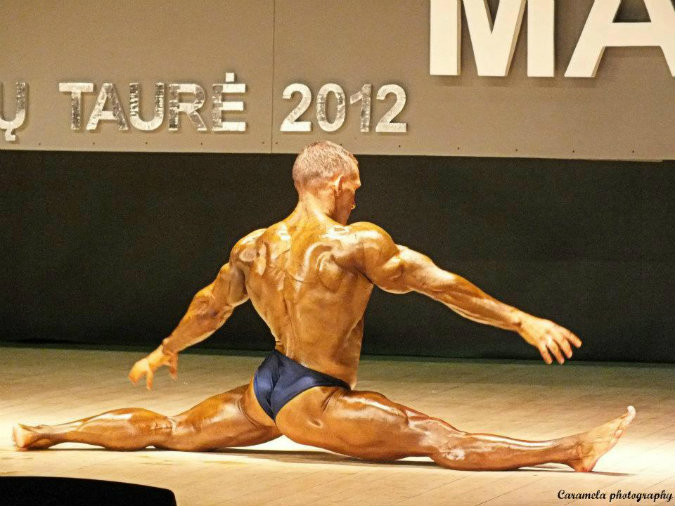
But surely up to a point? I find it hard to believe that guys growing so much meat on themselves that they can't clap their hands over their head get only largely positive health effects.
How's having hand, that when shaken by somebody feels like kaiser roll for them, improves health?
> I feel silly that I'm even bothering to justify myself to an internet stranger.
Sorry. No offence meant. I can respect bodybuilding as a hobby (part of life that has self contained meaning and brings pleasure by itself). I just see people doing it as if it was a mean to something and that's what eludes me (apart from, growing muscles to attract some girls, I get that).
> I find it hard to believe that guys growing so much meat on themselves that they can't clap their hands over their head get only largely positive health effects.
Muscles don't make you inflexible. Inflexibility is what makes you inflexible. Olympic weightlifters and gymnasts are both heavily muscled with high mobility. Try overhead squatting some time. It's harder than it looks.
A common cause of difficulties is in benching heavily without working the shoulder through external rotation. You see it a lot in powerlifters and in the general "bench bro" population.
> I just see people doing it as if it was a mean to something and that's what eludes me
I lift weights for a number of reasons. Primarily to get better my sport, which is ... lifting weights.
To add to your point about flexibility: I am vastly more flexible now than before I started lifting, for the simple reason that there's just no way I'd be able to execute even "simple" lift like the standard powerlifting lifts (that's bench, squats and deadlifts for the non-lifters) without hurting myself without being reasonably flexible.
To extent you get improved flexibility from lifting with proper form, but if you don't get flexible enough, you've got no choice than to work on it in other ways: Staying inflexible while lifting is a surefire way of getting hurt badly.
Body builders can "get away" with less flexibility, but as your pic shows they certainly don't have to be less flexible.
Building muscle is not equivalent to body building. Body building is a distinct sub-culture within the strength sports. Not everyone who lifts is interested in getting as big as possible.
Up to a point yes. A point of 200-220 lbs of muscle on a 6' frame.
When people take steroids to gain muscle beyond that it's not healthy. Also a beginner in a plateau who can only bench 160 has no business taking steroids, he's not the target audience.
Also weird hypertrophy routines dependent on machines, ignoring the core free-weight lifts aren't healthy. Many bodybuilders have muscle in unnatural places, which screws up their flexibility, mobility, and make them look disproportionate. Freakishly big bodybuilders spend hours stretching to avoid becoming muscle bound.
These practices give weightlifting a bad reputation but are easily avoided by not practicing them.
> I just see people doing it as if it was a mean to something and that's what eludes me (apart from, growing muscles to attract some girls, I get that).
If it helps put things into perspective - it's a rare person who wakes up and wishes that they were weaker than they were the day before. However, that's precisely what happens to you if you don't engage in resistance training; this is especially true the older one gets.
Surely you're feigning ignorance. People find muscle sexually attractive and associate it with power in social situations. I'm not very muscular myself, but it would be pure sour grapes not to see the benefits.
I can believe that it's true on average and that it can be useful for lots of people. I wonder if nowadays that's still something biological, or rather cultural indicator like pale skin in middle ages, or tanning more recently, that a person has much free time on his hands so is socially above average.
> associate it with power in social situations
I never seen anyone doing that. I never seen person with above average muscles in position of power. Is there some research about this?
Yeah, I heard he was an actor. I watched some of the movies he was in, but I didn't see any acting. :rimshot:
Anyway, getting back to your original point, correlation between height and income is well established (e.g. http://www.apa.org/monitor/julaug04/standing.aspx) It doesn't seem unreasonable to suppose that other aspects of an imposing presence, like muscularity, would also effect income. (Up to a point. I think there is social pressure against excesses of muscularity.)
Height correlates with income; an appearance of health and vitality is likely important; but I highly doubt muscularity beyond what you'd get from a normal healthy lifestyle and good genes will have a positive influence on how others judge you in the world at large (at the gym or similar context is different, of course).
I don't know what research has been done, but my own snap judgements of unusually muscular people tend to be negative; couple the muscles with an exaggerated strut and they go strongly negative.
I joke that I wear my coke-bottle glasses to avoid been mistaken for a professional rugby league player. It's half true. The stereotype of a meathead is neatly offset by the stereotype of an arch-nerd.
I use weight lifting as a way to release any frustrations or anything. Its a great way to get my mind off of things for a while. Im 6'2". At 18 I weighed 165. Now at 24 I weigh around 240 with not a little fat. I'm not cut or anything, but you can tell my bulk isn't just fat.
I understand not getting why people want muscle. I don't understand why people want excessive amounts of muscle (read pro bodybuilders). I do however enjoy the feeling of having greater than normal muscle mass, in and out of the gym. In the gym it feels great to be able to lift decent amounts of weight. Outside of the gym I find a certain amount of respect received for having more muscle. Like the article pointed out about the people on the sidewalk, people give you more space. On the functional side of things I enjoy playing physical sports when I can such as football and more-physical-than-it-should-be Ultimate Frisbee. Even in sports like disc golf though having extra muscle means I can throw farther etc. I also am able to help friends move, do any heavy lifting family members need done, etc.
I could probably go on but I think the main thing is that it depends on your lifestyle. I will say this though: I didn't know how handy having muscle could be until I started building.
I would not work out if not for the health benefits.
That said, after I got a bit of muscle some chores became much easier. Carrying luggage or groceries, or squatting to pick up or manipulate something down low. I just had a baby, I suppose it will be much longer before he grows heavier than my capacity for carrying him.
The aesthetic and self-esteem boost are also something to consider, though my muscles are barely noticeable by now.
One reason would be to build up muscle reserve as well as bone density (the resistance/pressure from training seems to improve osteocyte function), so that you're at less risk of injury later in life. This is with normal weight training, though, not hardcore bodybuilding and certainly not with adding fancy stuff or anything.
During the year-to-date(starting in January) I put on about 25 pounds of muscle. The motivations were a mix of vanity, desire for general well-being, and the increasing recognition of my own mortality as year 30 draws closer. (w/r to this last: knowing that I'll get old and lose capability, I want to try to experience life in many dimensions before I lose the option entirely.)
And I guess I got all of that. In fact, it only improved my self-awareness, since even though you can build yourself up to look tough, no amount of training is going to stop a bus from hitting you. And you get reminded of that every time you go in and train to failure. That is really the essential conflict: "why even bother" vs. "try to be the best you can be."
As a counterexample, one of my PE teachers ripped his achilles tendon, when he was startled by motorcycle passing close. I doubt he'd be able to hurt himself like that if his calf were average.
> I never seen the point of growing additional muscle tissue
There are multiple answers to this:
- look at the two pictures he puts in the article and ask yourself which one would your partner prefer?
- working out with weights(steriods asid) has been shown to have numerous health benefits, increased mental competence, longer life span, ability to eat more( if you like eating ), better sleep, etc.
> What's more, if your lifestyle and diet doesn't match your newly grown muscle tissue the body will adjust and all your effort to grow it will be gone in few weeks/months.
This is true, unfortunately its true for every single facet of life.
- I was an engineer in school, I've since forgot most of my thermodynamics course because I no longer use that information. However, I don't regret learning that information
- I used to be able to run a marathon but since having kids I no longer run for hours at a time, and hence, I"m not longer able to run a marathon. However, I don't regret running one.
In short, I don't really see the statement, if you don't use it you loose it as being a valid criticism of weigh lifting as it applies to many other facets of life.
Basically, you should plan you old age ahead of the time.
You will lose your muscle tissue with the age and it will happen pretty fast.
As the heart is also a muscle tissue, your heart will degrade.
The muscle tissue can be considered a separate organ of the human body. It's purpose to make sure every other organ is working properly, basically. Not on the "control" level which is what brain does, but on "demand is on this" signal that goes to brain. Your body is evolutionary constructed to support muscles and brain. If you do something we did through our evolutionary process, your muscles adapt (and other functions follows) and your brain grow stronger.
Training muscle makes body to produce excess BDNF hormone (brain-derived neurotrophic factor). The level of BDNF hormone after resistance exercise is about 40% higher than in rest, and it then promptly goes lower to also about to 40% of the rest condition (indicating quick utilization).
This is just an example of evolutionary protection of the brain.
The aerobic exercise has shown to provide cognitive benefits for older age (and even young age, there's correlation between university grades and physical activity). But, if you want to be very enduring, you have to do heavy resistance training: http://www.ncbi.nlm.nih.gov/pubmed/23914932
And last, but not least.
Man and women have about the same mechanisms regarding erotic arousal. The venous blood goes into cave bodies in penis or clitoris and veins at exit are (partially) blocked by special muscles. Cialis, for example, blocks destruction of special agent that reacts to nitric oxide in the venous blood and makes those special muscles to contract, blocking the blood. The side signal of protein synthesis is the higher level of NO in the blood. Higher NO level makes more probable the reaction that produces arousal, thus makes the sexual arousal more probable (or more stable). Protein synthesis occurs after muscle training sessions. So, if you want a healthy sex life, you better do weight training.
Muscle is what gives your body its ability to move. It's involved in the endocrine system (as this rather crappy article illustrates), it is heavily involved in your metabolism and energy levels, especially including blood-sugar regulation. Building muscle, engaging in regular physical activity (lifting and cardio), and eating healthily (minimal processed carbs) will greatly reduce your likelihood of developing metabolic syndrome and (type II) diabetes. Many people can control T2 diabetes completely through strength training and exercise.
It also helps in injury avoidance, improves your posture (assuming you're training in a whole-body mode, not just chest+biceps). Load-bearing strength training also strengthens bones, joints, and connective tissue. And you can pick up heavy shit and not get tired.
As you get older, starting in your 30s for most people, your body is losing muscle mass at the rate of about a pound every year or two (this is called "sarcopenia"). Eventually this starts effecting your body's ability to regulate body fat, and though your weight may not change, your body composition does, with fat tissue increasing as your muscle wanes.
Most people look better with more muscle rather than more fat, if you're into vanity.
And you should end up with a much better appreciation with how your body works and responds to training, diet, and recovery.
you have to feed it and lug it around.
Well, yeah, there is that feeding it. But you've got to eat anyhow. You might be boosting your caloric intake by a few hundred calories -- a cup of oats or so.
if your lifestyle and diet doesn't match your newly grown muscle tissue the body will adjust and all your effort to grow it will be gone in few weeks/months.
So long as you continue to train, your body will retain most of its gains. It's easier to retain muscle than it is to grow it, so lifting only once a week or even once every two weeks may be sufficient. But yes, it is a lifestyle committment -- your body is what you do with it.
And you seem not to be grasping the point: your muscle is the part of you that does the lugging. More of it makes things easier not harder.
As for my own experience, I'd found that adding strength training to my routine has helped me in many ways. It's more than worth the time and commitment. And though I've never sought artificial enhancement, my results have been more than satisfactory.



What's more, if your lifestyle and diet doesn't match your newly grown muscle tissue the body will adjust and all your effort to grow it will be gone in few weeks/months.
Instead of downvoting, please enlighten me about the benefits of growing few pounds of muscle tissue in places you don't really use in your daily life.