The low fuel, low wiper fluid, and forward collision warnings sound like they were all implemented a little clumsily.
What do you think the best implementation would look like? Seems it would still have to strike a balance. It's dangerous to tell the driver they're low on fuel if we distract them. But it's also dangerous for a driver to run out of fuel on the highway if we didn't catch their attention.
Also guessing you’re relatively detail oriented and don’t run out of gas, per:
“I don't want my car to draw my attention to itself for anything less than a critical engine/tyre pressure failures.”
> What do you think the best implementation would look like? Seems it would still have to strike a balance.
Somehow a small amber light (in the shape of a fuel pump) and a chime has worked for decades and there haven't been hordes of drivers stranded as a result. Something your grandmother could easily understand.
10-15 year old cars maybe give an additional small information message in the cluster easily dismissible with a steering wheel button.
No, the problem has been the mass importation of tech industry rejects into the car companies, as if the car companies haven't been quietly and successfully writing embedded software for 50 years, who brought their terrible habits with them. Like a need to "reinvent" UIs every six months.
Cars are safety-critical machines. They are not a place for "creatives" to experiment with UI design.
Sadly marketing drones think everybody wants a Tesla-style "everything is a screen" design whereas a 1999 Toyota pretty much had it right.
This isn't difficult. It requires no "innovation". Analog tach and speedo with idiot lights for critical alerts (there is literally an ISO standard for this) should be mandated by law. Substitute tach for a battery monitor in an EV.
EVs are the worst of both extremes. Either the entire interior is a touchscreen or you have something like the Slate, where there isn't even a radio. A room full of geniuses and what they come up with is a bluetooth speaker holder. Unbelievable, you can't throw in a DIN radio like a 1987 Datsun? Why can't EV manufacturers build a "normal" car?
> Sadly marketing drones think everybody wants a Tesla-style "everything is a screen" design whereas a 1999 Toyota pretty much had it right.
they also had to redesign the door handle and people have gotten stuck in the cars because of that and died. not just one isolated incident... more than one case of the car door not working because it's electrical only and the backup physical release mechanism is under a door panel you need to pop off and reach inside to pull after you just got into an accident and are physically disoriented.
What the fsck possessed manufacturers to come up with that stupid recessed door handle? I think I might actually hate that more than touch screen climate controls.
Airplanes have had fully manual flush door/hatch handles for decades, and a handful of cars have imitated them. The electric retracting handles are pure gimmick.
Look at that door handle. Fully flush, NACA profile scoop in the bodywork to insert your finger behind the trailing edge of the door and flick the little lever up to unlatch it.
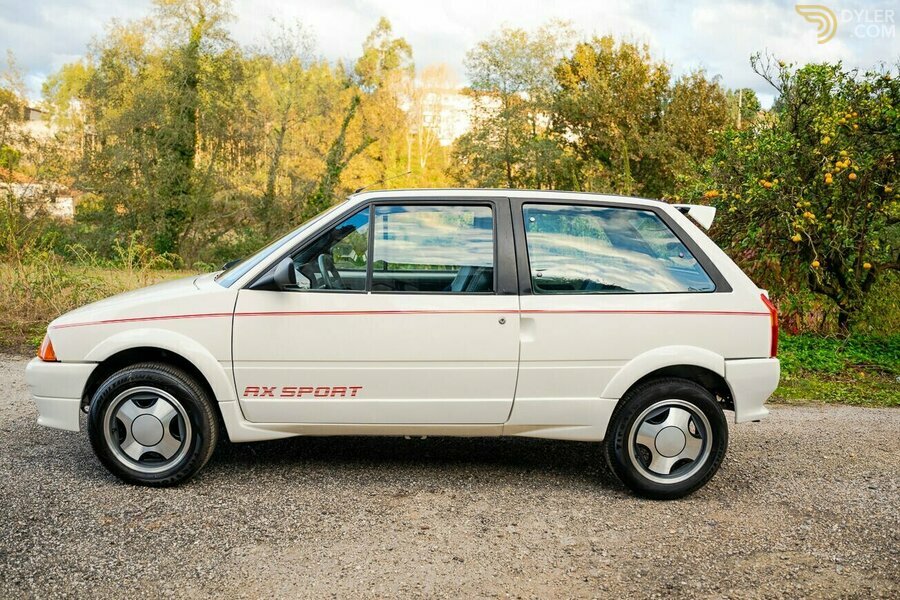
Give me that, please. I wish I'd never sold my 1991 Citroën AX GT, it was so quick and quiet. Hardly any wind noise, so it must have been very aerodynamic.
Apparently some engines now have a solenoid-operated shroud that pops up to surround the water pump impeller, so if the coolant is still warming up it doesn't circulate. This is supposed to reduce the parasitic load on the engine from the ancillaries.
I can't help but think that the water pump must require about 3 brake gerbil power to turn, and the weight of the solenoid, plunger, spring, shroud, and extra cabling - not to mention more seals to go hard and leak - probably takes more power to haul around.
I don't really care about a car's 0-60 time or fractions of a mile per gallon. If you want to save fuel, lighten your right foot.
I want the car to be simple enough to be reliable and repairable when it eventually does go wrong.
I agree with everything you said, but I believe the pump shroud is for faster engine warmup, not saving a fraction of a horsepower. Cold engines run rich, producing more hydrocarbon emissions, and the cold startup phase emissions are heavily penalized. There’s also additional wear on the engine due to cold oil and looser tolerances, which affects nearly every aspect of the engine.
It might be, yeah. But why wouldn't the thermostat solve that problem, since it won't let water through the rad? And wouldn't the faster warmup come at the expense of the heater taking longer?
If you really wanted to not run the coolant pump until you'd got the engine a little warmer I would have thought a magnetic clutch like an aircon compressor would have been better. Although these days, maybe even an electric pump could be more efficient.
The thermostat bypasses the radiator when cold, but not the engine. The coolant has to be allowed to flow in order for the hot coolant to fully open the thermostat. Being electronically controlled means there just needs to be a sensor near a known hot spot to trigger flow from the pump.
I’m not familiar with the impeller shroud you mentioned, but I looked it up and the description seems to agree: “This pump includes the shroud and control valve to restrict flow while the engine heats up.”
Whether or not it affects the time required for the heater core to be operational would depend on how they decided to route it, and if the solenoid offers variable positioning. I imagine it is variable, otherwise they’d create thermal shock every time the engine heated up and the pump suddenly started flowing colder coolant through the block, so technically it should be possible to fully replicate the general functioning of the thermostat and heater core. Now that I think about it, it’s most certainly variable and it’s why they didn’t go with a clutch system.
It's not variable, it just pulls in and out with a solenoid, either fully surrounding the pump or fully retracted.
I hadn't thought about the thermal shock thing but I did wonder how it could possibly help the coolant warm up if it's not circulating at least through the block. The engine doesn't warm up evenly.
Oh wow, it’s upsetting that it’s not variable. The total system might hold 2x (or more) of the amount of coolant in the engine water jacket. When the coolant around the engine gets up to ~200 degrees and the pump suddenly snaps to 100% it’s going to flood the engine with coolant at ambient temperature. Imagine getting the engine up to operating temperature then dropping it into a swimming pool; even in the kitchen you find out that’s what causes pans to warp and glassware to shatter, and the engine is just a funny shaped pan with bolts.
My only other guess is that it’s not 100% on/off, like maybe a bit is still allowed to flow when “off”, but then it would still need to bring the entire coolant mass up to temperature so I’m not sure how that would be a benefit for faster warmup. Either there’s some clever engineering I’m not seeing, or you’re buying a few points of regulatory compliance for them by needing to replace head bolts and gaskets sooner.
> Analog tach and speedo with idiot lights for critical alerts (there is literally an ISO standard for this) should be mandated by law. Substitute tach for a battery monitor in an EV.
You don't need a tacho. Some people add them in, like the Mini dashboard in the pic below, but they are absolutely not necessary. We managed fine without them for long enough.
Notice something? Both have the fuel gauge, Volvo has a clock but posh models had a tacho, Rangie has a tacho, then both have the speedo, then the temperature gauge.
The Volvo has the idiot lights along the top, the Range Rover has them along the bottom - and in the middle a 20x2 LCD (which in that one looks a bit worse for wear) which shows the odometer, gear selection, and occasionally lies about fault conditions.
Doesn't it remind you a little of how aircraft have a standard "Six Pack" layout for the flight instruments?
See also Mercedes W115 and W123 240D. Even the ones with a manual transmission had a clock where the tach would go. The speedometer had a series of dots at particular speeds that indicate the shift points for each gear (e.g. 1 dot for 1-2 shift, 2 dots for 2-3, 3 dots 3-4). I'm not sure whether a tach was even an option. The higher spec models had them, though.
Yeah my 300TD did as well. As you well know the wagons were super fancy though they had all the bells and whistles (except the sunroof, which was manual--and awesome!).
Fantastic machine. I drove mine without a power steering pump for about 6mo. The giant steering wheel helped a lot. Having individual V-belts to all the accessories instead of one serpentine belt saved me a tow and a repair bill more than once. My 1995 80 series Land Cruiser is built very similarly--it's a system that's designed to take battle damage and keep on going, but in sublime comfort the entire time.
EDIT: I just remembered the shock absorbers in the front bumper. IIRC in the owner's manual it said you can crash into things at up to 5mph with no fear of damage. I never tested that.. A Subaru did run into one of my fenders, though. The fender was bent in at the wheel arch maybe 3". The poor Subie suffered a punctured A/C condenser, radiator, and the plastic bumper shattered. I yanked the dent out of the fender (more or less) with a prybar and drove away. The Subaru went home on a rollback.
> What do you think the best implementation would look like?
We already had one! Dashboard indicator lamps have been an international standard (ISO 2575) since 1982.
> But it's also dangerous for a driver to run out of fuel on the highway if we didn't catch their attention.
Yes, it is. But the key word is "if". The product folks involved in making these UI/UX decisions were more concerned with whether or not they could (read: "chimp attract" for "feature parity" to "drive sales") than with whether or not they should (read: "should we be manufacturing two ton death machines that act like nannies?"). Where is the research that provides the answers to the questions "how likely is it that the driver isn't aware of how much fuel is in the vehicle?", "are our customers really as stupid as we think they are?", or even "what's the downside of training our customers to accept a more mindless state of existence while piloting giant metallic flesh-tearing bone crushers packed full of explosive hydrocarbons and squishy humans?"
> The general public though… uh oh!
You can come down from your ivory tower at any time. We have tacos down here and we all enjoy them.
To quote the late, great Lou Holtz, "they put their pants on the same way we do". I don't think there's ever been a time in all of my years on this planet that I've gotten into a car to go on a highway journey of any length and not looked at the fuel gauge. Oftentimes, my passenger will even ask me how much gas is in the tank. Glancing at the fuel gauge should be the first thing that any motor vehicle operator looks at when climbing into the captain's chair. Maybe I'm at that stage of life where I'm no longer capable of comprehending the manner in which the younger generations experience the world, but getting into an automobile and driving off without knowing how much fuel you have is like walking out the front door without confirming that your shoe laces are tied.
This constant othering of "the general public" without any research to back it up really grinds my gears, to use a contextually appropriate idiom. Please stop.
I wanted to acknowledge the user likely has above average faculties. “why would anyone use Dropbox,” “you can already build such a system yourself quite trivially by getting an FTP account, mounting it locally with curlftpfs, and then using SVN or CVS on the mounted filesystem”.
Zero times I’ve run out of gas. Don’t we pass someone walking with a gas can on the highway every year though? Dangerous, slightly safer if you use the fuel delivery service from AAA.
I admit I do not know quantitatively e.g. how popular that included-with-membership free 5 gallons (AAA).
Probably a million features I’d spend money on before trying to “fix” the fuel light though!
> Don’t we pass someone walking with a gas can on the highway every year though?
No. I see something like that every year on television, but not in the real world. If you've seen something like that every year, let me ask you a question: was the gas can empty or full? Gait while lugging five gallons of gas looks very different than gait while slinging around an empty can. Then, ask yourself whether or not you (or anyone you know) carries around a spare gas can in their vehicle.
Successful gaitcheck buddy, satisfying insight behind that question
Accordingly I must revise my estimate down :D _(as useful as an eyewitness!)_ I could probably commute all year without seeing a walking gas can or a tow truck filling a car on the roadside. It is difficult to estimate how long I might go before seeing either one of those things again. Maybe next time I will take notice of the vehicle model+year and driver’s demographic.
Maybe I will see an invasive fuel minder system on TV first haha
> What do you think the best implementation would look like? Seems it would still have to strike a balance
Others have explained how the old tech worked well. But let's assume new tech (touch screens), and see what can be done.
There are urgent messages and non urgent messages.
Non urgent messages can be shown when starting the car and requiring the driver to acknowledge them. low wiper fluid - non urgent. This could be a list requiring ack for everything. Recently on my BMW they got the smog check year wrong, and it kept warning me for months before I realized I could change the date for the alerts - same should be possible for low fluid - Ok, I acknowledge, but stop warning for next 14 days (or 2 months).
Urgent messages have to be blocking.
Low gas would be non urgent when you have 50 miles of gas left, but could become semi-urgent (more prominent) when you have less than 50. Also, this is where the tech could be useful. If the car has internet and knows there are no gas stations within 50 miles, or whatever the current range is .... it should make it super prominent. That knowledge processing, aka AI in modern era, would be so awesome.
But it requires design for usability, not one catch all solution.
I have never been especially bothered by fact that warning for low wiper fluid was well getting somewhat less wiper fluid... I don't use much, but it never felt like critical lack of proper early warning.
My car has only a small dashboard screen with some information and when something is alarming it is colored yellow or red for significance and pops up filling the screen, then after a little while minimizes to a little warning icon corresponding to the issue matching the color. Or I can hit a close button on the steering wheel.
For years, vehicles have had a little light that comes on when you are below about 50 miles of range. It's next to the fuel gauge. I've always heard it called the "walk light", which I presume is a reference to the fact that, if you don't do something, you may have to start walking soon.
My car has a little screen in the dash where it usually shows my range, or the current temperature - information that I check when safe to do so, but never very urgently. This is the perfect place for a warning about low wiper fluid.
As for forward collision warnings, ehhhh. Maybe that should beep loudly, but it should almost never be wrong! (A false alarm could easily mean I slam on the brakes and get rear-ended, so that has to be balanced with the safety advantage of the true alarm.)
Forward and rear collision warnings have saved me several times in 3 different cars, including slamming on the brakes as I was backing up and then a MUNI bus that I didn’t see flew by.
I’ve also been in 4 accidents that were my fault (one on the same street, a MUNI bus blocked my view of another car that had the right of the way) and 2 that weren’t but I wasn’t able to avoid them.
I will always buy a new car with the latest tech because I acknowledge I’m a below average driver and those warnings (inc the subtle “someone is in your blind spot” light) are helpful to me.
PS I also prefer physical knobs (especially on the steering wheel) and don’t have cars with giant touchscreens.
> all of the rest of us know for a fact we’re above average drivers
The boring reality is that the vast majority of us are average, and average turns out to be pretty safe. The people causing multiple at-fault wrecks are not merely below average, they are way below average.
Sometimes wonder if all speed trap cops would make us safer if they mostly ignored speeding, drove unmarked cars, and all day long nabbed tailgaters making multiple aggressive lane changes.
That still leaves the bad or distracted drivers, but thankfully much of the time a little extra brakepad is enough to keep a defensive driver out of the body shop.
The fix for your repeated at-fault accidents is not more mandatory technology in cars.
The fix is you should be taking MUNI more often and a defensive driving course. Maybe be forced to drive a manual transmission car through Pac Heights until you can't. Your insurance premiums must be crazy.
Those warnings just don’t need to exist. I have a car from 2002, it has none of those and it’s fine, totally fine.
There is a fuel gauge I look at to see my fuel level, when I’m out of wiper fluid it just doesn’t work (I have extra in my trunk so no big deal). I don’t need a noise to tell me there is a car in front of me, I’ve been driving this car every day for 15 years with no accidents so obviously a collision alarm is not required for safe driving.
How about we stop infantilizing people and expect some base level of competence.
Agree. The only recent UI/safety advancents have been a good rear & side camera; and blind spot detection & warning system. The rest are for folks who should not be driving a vehicle at all.
Until reliable FSD becomes widespread, we ought to stop with these ‘incremental’ UI changes for the sake of it. Like the ridiculous ’take a coffee break’ indicator which is also incorrect mostly
>recent UI/safety advancements have been a good rear & side camera
With the reports of spyware tech possibly coming to California cars “in 2027” (prob not!), I saw someone complain about the rear camera adding costs. But those families impacted by backover accidents fought for this cheap technology for a reason.
>The rest are for folks who should not be driving a vehicle at all.
I may be able to be convinced that there are so many drivers on the road who need to get off that it’s worth investing in technologies for people who should not be driving. (I’m just thinking of a private local system that has a hunch whether you are entirely absorbed in your phone or not, and if & how much I would like the public to pay for it so they don’t hurt me)




What do you think the best implementation would look like? Seems it would still have to strike a balance. It's dangerous to tell the driver they're low on fuel if we distract them. But it's also dangerous for a driver to run out of fuel on the highway if we didn't catch their attention.
Also guessing you’re relatively detail oriented and don’t run out of gas, per:
“I don't want my car to draw my attention to itself for anything less than a critical engine/tyre pressure failures.”
The general public though… uh oh!