The relevant factor is whether it's more expensive than peaker gas plants. Because that's how you get energy when the wind doesn't blow and the sun doesn't shine. And no, battery storage - or any storage other than pumped hydro, which is already in heavy use - is a drop in the bucket; it doesn't even come close to covering serious shortfalls.
Nuclear power costs about as much to run 24/7 as it does to run intermittently, because the vast majority of its cost is in construction. So building enough nuclear power to satisfy demand when intermittent sources aren't producing makes those intermittent sources totally redundant.
Suppose you have renewable sources that on average generate 100GW. Well, some weeks they're going to average 90GW -- and that will be quite common -- in which case you'd need 10GW of something else. The long-term average (e.g. over 48 hours) is what matters because you'd always need to smooth out the short-term load with batteries.
Some weeks you'll need to make up 20GW, but that will be less often than a 10GW shortfall. Even less often, 30GW. Sometimes, but very rarely, the whole 100GW, or at least say 90GW.
This means that the first 10GW of peaker plants will be quite economical because they get used e.g. 15% of the time, but the last 10GW will only get used <1% of the time and not be competitive with nuclear running ~100% of the time.
So what you end up with is, say, 60GW of renewables, 40GW of nuclear and 50GW of peaker plants that run the ~5% of the time when you have low renewable generation. Instead of needing 100GW of renewables and 90GW of peaker plants, of which 40GW is almost never used.
> Suppose you have renewable sources that on average generate 100GW. Well, some weeks they're going to average 90GW
Renewables' fluctuations are way, way bigger than 10%. Solar, by definition, is going to be producing 0% of output 12 hours a day on average. Wind has fluctuations of over 10x as well:
It's more like, you have renewable sources that produce 100 GW at their times of peak output. And for a couple months of the year they're producing 10GW. If you built 90 GW of nuclear power, then you could just scrap 90% of your renewables and run your nuclear plants all year round. Again, nuclear power plants are just as cheap to run constantly as it is to run them intermittently.
I reiterate that we're talking about the daily average and not the instantaneous generation.
You have solar panels that generate 100GW average, i.e. 200GW during sunlight and nothing at night. You have batteries to match this up with the daily load.
But then it's more cloudy than usual for a couple weeks, so your average generation from solar is 50GW, or 10GW, or what have you, depending on how cloudy it is. You need something to make up the difference that week or the batteries run down and the power goes out.
But because averaging 90GW over a day (when the typical average is 100GW) is a lot more common than averaging 10GW, the first 10GW of peaker plants is economical against nuclear and the last 10GW is not. And the total of nuclear + peaker plants has to add up to ~90GW because there will be times when you only average ~10GW from renewables.
> You have solar panels that generate 100GW average, i.e. 200GW during sunlight and nothing at night. You have batteries to match this up with the daily load.
And that amount of batteries is absolutely massive. To put this in perspective, the US uses about 500 GW of electricity, or about 12 TWh per day. That's 6,000 GWh for just the United States. This is an incredible amount of storage, over 10x the annual global battery production.
This is why talking about "average production" of intermittent sources is simplistic. You need to dig into the degree of overproduction and storage required to even out that intermittency. But including those factors makes renewables way more expensive, which is why people don't like to talk about these factors.
> This is an incredible amount of storage, over 10x the annual global battery production.
It's a lot. Battery production would have to increase. But it is increasing, and it's not an impossible amount.
You also cut it to less than half by doing the thing mentioned above, because the daytime load is higher anyway. If 40% of the generation comes from nuclear, that's 80% of the nighttime load and now you only need 20% as many batteries.
> It's a lot. Battery production would have to increase. But it is increasing, and it's not an impossible amount.
Is it? Global battery production is about 500 GWh per year. A single digit percentage of that is going towards grid storage, it's mostly used for EVs and electronics. Even if we completely halted EV production, and dedicated 100% of global battery production to grid storage it'd take over a decade to just satisfy the United States' grid storage requirements. And that's just for diurnal storage, not seasonal storage. And again, that's dedicating 100% of global battery production to just one country.
While battery production is increasing, so is electricity use. As transportation and other industries decarbonized, and as poor countries grow richer, electricity use is going to rise and so will the storage requirements.
> because the daytime load is higher anyway
Nope, in fact it's the opposite. Load typically peaks after sundown, at around 8pm. This is why solving the duck curve is so hard. Solar produces no energy during peak demand: https://en.m.wikipedia.org/wiki/Duck_curve
> A single digit percentage of that is going towards grid storage, it's mostly used for EVs and electronics.
That's fine, it makes sense to put it in EVs because EVs are de facto grid storage. You charge them during the part of the day with the most surplus generation and they even out the curves.
> Even if we completely halted EV production, and dedicated 100% of global battery production to grid storage it'd take over a decade to just satisfy the United States' grid storage requirements.
That's assuming production doesn't increase at all, and that you want a 100% renewable US grid instead of e.g. 60%.
> And that's just for diurnal storage, not seasonal storage.
Batteries aren't suitable for seasonal storage. Their contribution is to smooth out the load.
Suppose during a cloudy week you would have a 50GW shortfall from 6PM to 10PM and a 10GW shortfall from 12PM to 6PM, but a 20GW surplus from 8AM to 12PM. Well then what you really have is 7.5GW average shortfall and by smoothing out the load with batteries can get by with 7.5GW of peaker plants that week, instead of needing 50GW at 8PM which then sits idle from 10PM to noon.
> While battery production is increasing, so is electricity use.
The main driver of this is electrifying transportation. But because cars have built-in storage, you can charge your car during daylight and substantially all of the new generation capacity can be renewables without encountering short-term intermittency issues.
> Nope, in fact it's the opposite. Load typically peaks after sundown, at around 8pm.
You can take a look at your own graph. The load during peak solar generation (~3PM) is >25GW, compared to ~20GW after midnight, and that's during the autumn rather than the summer. Air conditioning load aligns extremely well with solar generation.
The peak load is around 8PM, but the peak load and the minimum load are both after dark, and the daytime average is higher than the nighttime average.
EVs can only be used as storage under very specific circumstances. It assumes people drive to the work in the morning have charging stations at work, and don't commute very far. In reality lots of people don't have charging stations at work, and charge their cars in the evening when solar isn't producing. Also, there's loads of people doing errands during the day, or utility vehicles transporting cargo. These are going to be used consistently through the day and charged at night. Electric semi trucks aren't going to be helpful for grid storage. And they burn a lot more energy than a passenger sedan. And lastly, few grid operators are going to accept that their grid storage may drive away on masse during the holidays.
> Suppose during a cloudy week you would have a 50GW shortfall from 6PM to 10PM and a 10GW shortfall from 12PM to 6PM, but a 20GW surplus from 8AM to 12PM
> The load during peak solar generation (~3PM) is >25GW, compared to ~20GW after midnight, and that's during the autumn rather than the summer.
But again, peak demand isn't at midnight it's at 8pm. You can't just hand-wave away the challenge of meeting peak demand when intermittent sources aren't producing.
> Air conditioning load aligns extremely well with solar generation.
And it aligns even worse during the Winter: solar is producing the least amount of energy, cloud cover is at its greatest extent. Most homes are heated by gas, and when that gets decarbonized it's going to put even more load during the worst time of the year for renewables.
Definitely, rooftop solar is a great addition and a good way to reduce load due to air conditioning. It comports with what I've been saying this whole thread: intermittent sources are good when used opportunistically to supplement a grid primarily powered by non-intermittent sources. The downsides of intermittency are too great to be used as a primary source of energy, though.
Every battery you put in an EV becomes a battery you can use to balance the grid when the EV is scrapped and the battery still has 80% of its capacity left.
80% capacity does not mean 80% of life span remaining. Degradation is not linear [1] [2], a battery that's gone through enough cycles to drop down to 80% of its capacity is very close to the end of its life just a few hundred more cycles before failure. That would drive up the costs of labor as these recycled batteries would have to be replaced once a year or even more frequently.
Recycled EV batteries are popular in DIY communities because labor is free, and if they fail you still have the grid to fall back on. That's no the same case for grid operators. New LFP batteries have better economics than used EV batteries for grid storage, especially since they are both cheaper per watt hour and they have over twice the life span of most lithium-nickel-cobalt batteries used in EVs.
So you're saying your point about every battery going into an EV is completely irrelevant because grid batteries will most likely use different chemistries than EV batteries? That's fine too.
> It assumes people drive to the work in the morning have charging stations at work
That's a pretty reasonable assumption once electric cars are the majority of cars.
> and don't commute very far.
There are popular electric cars with a range on the order of 300 miles. The average commute is 41 miles round trip.
> Also, there's loads of people doing errands during the day, or utility vehicles transporting cargo.
The average person does not drive 300 miles a day in total, and so does not need to charge more than once a day in total. Utility vehicles will have larger batteries and more range, and will strongly prefer to charge during daylight because charging from solar will cost less.
> And lastly, few grid operators are going to accept that their grid storage may drive away on masse during the holidays.
It's storing the energy that the vehicle itself will use. If the vehicle leaves the area then so does its demand for electricity.
> During a cloudy week, you're going to have a shortfall all the time. Solar drops to 10-25% effectiveness with cloud cover
If your grid has 40GW of nuclear and 60GW average of solar (which generates 120GW during daylight) then the 120GW drops to 30GW and you have 70GW of generation, which could be less than the demand before noon. You can also run the peaker plants even though you already had a surplus in those hours so you can put even more into the batteries to have enough later in the day.
> But again, peak demand isn't at midnight it's at 8pm. You can't just hand-wave away the challenge of meeting peak demand when intermittent sources aren't producing.
Suppose you have enough nuclear to meet the demand at midnight, which is enough to meet half of the demand at 8PM. So now you need to satisfy the other half from batteries for four hours, because before 6PM the sun is still up and after 10PM the demand falls off to what you're getting from nuclear. So you don't need enough batteries to satisfy all of the demand for the 12 hours when there is no sunlight, you only need enough to satisfy half of the demand for those four hours.
> And it aligns even worse during the Winter: solar is producing the least amount of energy, cloud cover is at its greatest extent.
But there is more wind in the winter, and at night, when there is more demand for heating.
And one of the ways to decarbonize heating in cities is nuclear with cogeneration. Then you're not using electricity for heat, you're using the waste heat from the reactors, which chops off a large chunk of even the existing nighttime load.
Again, electric vehicles only work as storage if people can charge their cars at work, drive home, and then tap that storage over night.
Many vehicles aren't being used for commuting, they're used for work or running errands. They're going to be used during the day and charged at night. People aren't just going to become nocturnal in order to charge their cars. Someone who drives to work in the morning, goes shopping during the day, and picks kids up in the evening isn't going to be able to do all these chores at night.
What happens if someone's car is discharged over night right before a trip to Grandma's and now they don't have enough range? They're going to be pissed and stop letting the grid tap into their car.
> If your grid has 40GW of nuclear and 60GW average of solar (which generates 120GW during daylight) then the 120GW drops to 30GW and you have 70GW of generation
If you've got 50GW deficit over a week of cloud cover you need 4,200 GWh of storage to offset that. Consider that in many parts of the world, cloud cover can be present for a month or longer.
These are absolutely massive storage figures. The latter is about ten times the annual global battery output. And energy demand is much higher than 120 GW. US electricity demand is 500 GW. Global electricity demand is 3,300 GW.
> Suppose you have enough nuclear to meet the demand at midnight, which is enough to meet half of the demand at 8PM.
It's enough to satisfy 70% of the demand at 8PM. And since nuclear is just as cheap to run at 100% capacity all day long, it's better to scrap the bulk of your renewables because the nuclear plants make them redundant.
> But there is more wind in the winter, and at night, when there is more demand for heating.
This depends on geography. On the west coast, it's the opposite: wind produces the least energy during winter.
> Again, electric vehicles only work as storage if people can charge their cars at work, drive home, and then tap that storage over night.
They're storing the energy that they themselves use. You're not using it for your house, you're charging during sunlight and then driving home or to a restaurant after dark. It allows close to the entire demand for electric vehicles to be served from renewable generation.
> They're going to be used during the day and charged at night.
A supercharger adds 200 miles of range in 15 minutes. You go into the shop, plug into the charger in the parking lot and when you come back out in 15 minutes you don't have to charge again until tomorrow.
> What happens if someone's car is discharged over night right before a trip to Grandma's and now they don't have enough range?
They'll plug it in and charge it. Charging your car at night isn't going to be illegal, but it will cost more, so people will prefer not to, and then 95% of the charging will happen during the day.
Notice also that "overnight" is not synonymous with "darkness" -- if the sun comes up at 6AM and you leave for work at 8AM, you've had two hours of sunlight to charge your car while it was parked in your garage, and there are computers that can automate this.
> If you've got 50GW deficit over a week of cloud cover you need 4,200 GWh of storage to offset that.
Or 50GW of peaker plants, or 40GW of peaker plants and 20% of that amount of storage.
> And energy demand is much higher than 120 GW.
These are just example numbers for a hypothetical grid with 100GW of average demand.
> It's enough to satisfy 70% of the demand at 8PM.
In California, in October. Not in Texas in July.
> And since nuclear is just as cheap to run at 100% capacity all day long, it's better to scrap the bulk of your renewables because the nuclear plants make them redundant.
Nuclear is base load. It can make sense to build as much of it as there is base load demand, i.e. the minimum demand during any part of the day. But what do you want to do about the higher demand periods? Build extra nuclear plants that only operate 4 hours a day? Use battery storage with nuclear, even though that's way more expensive than battery storage with renewables?
> This depends on geography. On the west coast, it's the opposite: wind produces the least energy during winter.
The west coast has mild winters and thus less heating demand.
> A supercharger adds 200 miles of range in 15 minutes. You go into the shop, plug into the charger in the parking lot and when you come back out in 15 minutes you don't have to charge again until tomorrow.
Except very few parking lots have superchargers. And those that do, usually have just 5 or 10 for a parking lot of hundreds of spaces. This whole idea that a grid operator is going to accept that traffic conditions are going to potentially cause blackouts is not where near feasible.
> Or 50GW of peaker plants, or 40GW of peaker plants and 20% of that amount of storage
Right so ultimately the solution is: keep using fossil fuels. Great...
And a 10GW deficit over a week is still 1,680 GWh of storage. This is massive several times annual global battery production.
> Notice also that "overnight" is not synonymous with "darkness" -- if the sun comes up at 6AM and you leave for work at 8AM, you've had two hours of sunlight to charge your car while it was parked in your garage, and there are computers that can automate this.
Solar output is sinusoidal. Right after sunrise is still producing nearly zero energy.
> Nuclear is base load. It can make sense to build as much of it as there is base load demand, i.e. the minimum demand during any part of the day.
Base load is the significant majority of the electricity demand. It's not a small part of electricity demand, it's almost all of it.
> The west coast has mild winters and thus less heating demand.
Uh no? Maybe in California, but here in Seattle we regularly see nighttime temperatures below freezing.
> Except very few parking lots have superchargers. And those that do, usually have just 5 or 10 for a parking lot of hundreds of spaces.
The number of chargers increases with the number of cars.
> This whole idea that a grid operator is going to accept that traffic conditions are going to potentially cause blackouts is not where near feasible.
Pricing determines demand. Charging at the supercharger at the mall during sunlight is cheap so people go out of their way to do it, and the mall loves this because people come to the mall and buy things when they know it's a quick and cheap place to charge.
> Right so ultimately the solution is: keep using fossil fuels. Great...
Cloudy for an entire week happens, but it's rare. So 98% of the time you use nuclear and solar, then one week out of the year you use nuclear and fossil fuels instead, and you've got a 99% decarbonized grid.
Or you find something to burn instead of natural gas. You could quite plausibly have a one-week supply of biofuels or synthetic fuel, since it's for emergency use rather than everyday generation.
> And a 10GW deficit over a week is still 1,680 GWh of storage. This is massive several times annual global battery production.
Yeah, batteries don't really work for long-term storage. But the amount of batteries you need to avoid running the peaker plants on a normal day, combined with running the peaker plants 24 hours a day instead, gets you through a period of two or three days of low generation.
At that point you're doing demand suppression through pricing and things, but only when the period of low generation lasts for many contiguous days. And getting 50% demand suppression probably isn't reasonable, but 10% is, especially when you only rarely have to do it.
> Solar output is sinusoidal. Right after sunrise is still producing nearly zero energy.
"Right after sunrise" is nearly zero, but two hours after sunrise is more than 50% of peak.
And human activity is sinusoidal too. You start getting some solar generation before anybody is awake and you can put it into charging vehicles. Generation increases as more people start to wake up. Moreover, some people leave for work at 8AM, some leave at 9AM, some will charge at work or the mall, so you're still spreading the load throughout the daylight hours rather than trying to fit everything into the period immediately after sunrise.
> Base load is the significant majority of the electricity demand. It's not a small part of electricity demand, it's almost all of it.
Peak load in summertime is nearly double the base load.
> Uh no? Maybe in California, but here in Seattle we regularly see nighttime temperatures below freezing.
The average winter temperature in California is 46 degrees F, and California is >75% of the population of the west coast. The average winter temperature in Washington state is 33 degrees. The average winter temperature in New York, despite a more southern latitude than Washington, is 23 degrees. In North Dakota, still slightly south of Washington, it's 12.
The west coast has mild winters and less heating demand.
It also has a ton of existing hydro and existing high voltage transmission lines because the hydro is in the northwest but powers much of California, so you could fill California to the brim with renewables and then use the existing hydro as your batteries.
> the first 10GW of peaker plants is economical against nuclear and the last 10GW is not.
I'm not sure how well this works given that peaker plants have to pay for their fuel whereas nuclear - to a first approximation - does not; everything is factored in the building cost. So it's more like the first 10GW of nuclear baseload can displace a lot of gas use, whereas the last 10GW shortfall might still be efficiently covered by peaker plants if they're cheaper to build for the same capacity and almost never have to burn fuel. It works out to mostly the same outcome, though.
> I'm not sure how well this works given that peaker plants have to pay for their fuel whereas nuclear - to a first approximation - does not; everything is factored in the building cost.
It's not about the cost of nuclear, it's about the utilization of peaker plants.
If you build 10GW of nuclear, you generate 10GW 100% of the time. If you build 10GW of peaker plants, do you use it 15% of the time or 0.5% of the time? The answer to which depends on if it's the first 10GW of peaker plants (10GW shortfall happens frequently) or the last 10GW of peaker plants (only needed if the first 80GW of installed capacity was used first; 90GW shortfall happens very rarely).
Sure, but a peaker plant is providing capacity even when it sits unused. That's a valuable service, and it gets rewarded by usual electricity-market arrangements. So the relevant question is when can this service be provided more cheaply than the same amount of nuclear-supplied capacity.
The value of the service depends on how many other peaker plants there already are.
> That's a valuable service, and it gets rewarded by usual electricity-market arrangements.
This is the bureaucracy papering over the details like an abstraction layer. You want to look at the underlying economics when you're redesigning a system like this. This is napkin math but it should be directionally accurate.
Suppose we assign rates to the relationship between supply and demand in the power grid. The price of electricity set by how much demand exceeds supply.
Then you're going to have a base rate, call it R0, essentially what electricity costs off-peak on a typical day. This is the rate which is going to prevail for around two thirds of the time. Then you have your normal day peak rate, R1, this is what it costs in the early evening when there is low renewable generation and high demand, basically the higher cost of intra-day energy storage. This might prevail for 1/6th of the hours in a year.
Two thirds plus 1/6th, you still have another 1/6th, that's when something bad is happening. It's a bit cloudy today, rate R2, happens 10% of the time. More cloudy, even higher rate R3, 3% of the time. Overcast for the whole day, rate R4, 2% of the time. Overcast for multiple days, rate R5, 1% of the time. Overcast for multiple days in the summer during peak air conditioning demand, rate R6, <1% of the time.
Now you can calculate how much value a nuclear plant has, because it generates all the time:
Solar has to recover its costs from just R0, which is the lowest rate, but it can do that by generating for a large number of hours a year relative to a peaker plant, and because it's cheap. Batteries recover their cost during R1, which isn't as many hours but the rate is higher.
The first peaker plant gets R2 through R6, because it gets turned on as soon as you hit R2, i.e. you need more than you get from current generation + energy storage. The second peaker plant only generates at R3 through R6 because it doesn't get turned on until then, since the first one was enough during R2.
The last peaker plant only generates during R6 and has to justify its entire cost by operating only 0.67% of the time. Which is why R6 is the highest rate, but even then it's a tough sell -- much harder than the other peaker plants which operate during R6 and R5, R4, etc.
Whereas the nuclear plant operates ~100% of the time, R0 through R6, replacing both renewable generation on a normal day and peaker generation during a supply crunch. But it costs more to build. So it should be worth it to replace the peaker plant that only operates during R6, but maybe not worth it to replace the peaker plant that operates from R3-R6, and definitely not worth it to replace the peaker plant that operates from R2-R6.
That's one side of the equation. The other side that's being explored is to vary the demand side. Only use 90 GW when 90 GW is available, and run the aluminum smelters undercapacity when there isn't the solar power to run them at full capacity.
It's an interesting balancing equation that someone could make an interesting game out of.
> Only use 90 GW when 90 GW is available, and run the aluminum smelters undercapacity when there isn't the solar power to run them at full capacity.
That gets you a few percent for the things that work like that, but most of the load on the power grid isn't able to do that. You can't turn off the heat in the winter, which is going to be an even larger proportion of the load in the future than it is now as we transition from fossil fuel heating systems to electric. People demand hot water. Refrigeration is a significant load but you turn it off and your food spoils.
Electrifying transportation is also a mixed blessing here. It helps smooth out the day/night load because you can charge them whenever generation exceeds demand, but after a couple days you can't put it off anymore and then you've just got more unsuppressible demand.
I would expect heating to be one of the electricity use that you _can_ adapt the easiest. First by using heatpumps instead of resistors, and then with some inertia management to buffer (e.g. water tanks, or something)
We're largely not using resistors now, we're using oil and gas. Heat pumps use less than resistors but not less electricity than burning hydrocarbons on site.
Buffering systems can be effective for intra-day load shifting. You want to use electricity at noon and have heat at night. It doesn't work when you want to use electricity on Monday to have heat on Friday (tank would have to be too big and losses are too high) and it definitely doesn't work when you need heat on Monday but won't have the generation capacity until Friday.
Pumped hydro storage is approximately cost competitive with new nuclear. It depends on ease of incentives, building permits and finance mechanisms available for building new hydro vs nuclear. Estimated LCOE of new hydro in India for example is Rs9/kwh(~$100/Mwh) which is comparable to new nuclear estimates of $55-90/Mwh. China is also building pumped hydro at good pace. And pumped hydro doesn't have to fight entrenched anti-nuclear lobby while doing it.
US and EU storage incentives encourage battery storage schemes over pumped hydro though. They either expect cost of battery storage to become less than pumped hydro shortly, or the lack of construction firms lobbying for pumped hydro is making battery the prominent storage option.
Offriver closed loop pumped hydro just needs two football size fields hundreds of meter apart in elevation. Most continents have plenty of suitable locations for PHS, though they are distributed unevenly. According to the paper, there are 600k feasible locations for PHS world wide, or capacity to store 70% of global energy demand in 2017.
> Offriver closed loop pumped hydro just needs two football size fields hundreds of meter apart in elevation
A football field sized reservoir isn't going to hold much water unless it's deep. Realistic pumped hydro sites are much larger than 500 square meters. And those two reservoirs can't be too far apart, because excess lateral distance reduces output and increases the energy required to refill it.
It also needs to be close to a source of water in order to fill the reservoir and refill any loss due to evaporation.
It also needs to be close to a major highway otherwise the costs of construction will be immense because of the long distance that materials and equipment must be shipped. This is particularly problematic because most pumped hydro potential is in mountainous terrain where transportation is expensive.
And lastly, this site has to be close to places that have energy demand, otherwise you'll need to build miles and miles of transmission lines. This is also a problem because the places that have pumped hydro potential also have hydroelectric potential, and usually already generate electricity from dams. Norway and Brazil have huge pumped hydro potential, but already generate most electricity from dams.
The conditions for a viable pumped hydro sites are much more narrow than "two football field sized reservoir a few hundred meters apart in elevation".
The paper you cited just ran an algorithm over a terrain height map. It did not attempt to account for accessibility. Good luck developing the immense pumped hydro potential in Tibet. Pumped hydro would be great if we could teleport concrete, excavators, and turbo machinery into some of the most remote parts of the world. But unfortunately this is not in our capabilities.
Even if the 70% of global energy demand in 2017 estimate is off by a factor of five or so, that's still plenty of storage to cover for renewable intermittency.
I wouldn't be surprised if less than 1% of the identified hydroelectric sites were viable to build at all, and 0.1% were more cost competitive than batteries. Huge amounts of the identified hydropower sites are located in Tibet, which is far too remote to conduct big construction projects. Another big region with hydro electric storage potential is Brazil. But they already generate almost all of their electricity from renewables and they don't need pumped hydro. Again, the paper you cited just ran an algorithm over a height map. There was zero consideration of proximity to transportation, proximity to energy demand, and proximity to water to fill the reservoirs.
There are other fun options, a number already tested and being expanded upon.
China is building several "gravity towers" (different design to [1] but same concept), Australia is designing third generation (after a 1MW test pilot, and current 288MWh plant under construction) high temperature molten salt thermal energy storage tanks to night time buffer solar plants used to produce green methanol for use as a sustainable shipping fuel.
None of these have actually been used for grid storage. Heated sand has been used for district heating, but electric generation is more challenging because it requires higher temperature gradients. There's plenty of other ideas people are pursing: hydrogen electrolysis, compressed air, giant flywheels, ammonia, I could go on.
Why are people exploring all these alternative energy storage methods? Because grid storage is not feasible with current storage options. We're still looking for the silver bullet to solve grid storage. Will these new ideas yield storage at lower cost than the existing systems? Maybe, maybe not. A grid powered by primarily intermittent sources is viable if such a silver bullet is found, but that's a pretty big if to bet the future of the electric grid on. A very realistic outlook for wind and solar is that we saturate peak production, waste a ton of excess electricity, and keep burning fossil fuels because the silver bullet never materializes.
> None of these have actually been used for grid storage.
So what? As is clearly implicit to the meanest intellect in my comment above these are alternatives that are being built right now after having already passed pilot testing and now being scaled up for grid storage.
> A very realistic outlook for wind and solar is that we
overproduce during daytime here in Australia, have sufficient wind through much of the night to tick over, and use the excess to produce green hydrogen, ammonia, methonal, etc to buffer nighttime demand and for use in mining, transport and agriculture.
> So what? As is clearly implicit to the meanest intellect in my comment above these are alternatives that are being built right now after having already passed pilot testing and now being scaled up for grid storage.
No, they are not. They are still in the prototype stages. Gravity storage is still being prototyped. Heated sand is only being used for district heating. If you've got news about a real production deployment of grid storage using these systems, I'd be eager to read it.
> and use the excess to produce green hydrogen, ammonia, methonal [sic], etc to buffer nighttime demand
If we find a feasible way of doing these things. These storage schemes are theoretically possible, but as of yet they are not demonstrated to be viable at grid scale. The reason why most of the talk is around batteries is because they're the most viable storage option at the moment. Will one of the systems you listed deliver much better grid scale storage? Maybe, maybe not.
If your point is that intermittent sources are viable contingent on an energy storage breakthrough, then yeah I'm in agreement. But it's not exactly wise to bet the future of your electrical grid on a technological breakthrough that may or may not happen.
In California, battery storage is already far beyond a "drop in the bucket", and we are still in the early stages of large scale deployments.
I see a lot of replies that are using nationwide figures, but there is no reason that the CA model couldn't be applied everywhere... if it were cost effective to do so.
That last part is the important bit. There's no physical obstacle to doing this.
That will always be a possibility when systems fail, like it did during Texas winter storm.
If masses of people not having power sometimes is a fundamental part of the system design and not an extreme systemic failure, then that's completely unacceptable.
Ok, how often does California (or the US as a whole if we were going to do a nationwide system, or North America, or The Americas, etc....) go for weeks without sun or wind? I would think those could be known via historical data and used to model a system that works except in extreme situations.
I don't know the data - I was surprised to learn that half of California can run on batteries for 4 hours; that's actually impressive at present.
I keep hearing about how we need some sort of dues ex machina innovation to save us from climate change. Given the impressive improvements on renewable energy and battery storage, doesn't it seem likely that they are the best hope for such innovation?
To be clear, when I look at the data regarding carbon emissions and the implications there, I'm reasonably sure human civilization is boned, but is there any better hope than renewables? It doesn't seem like we ever really figured out nuclear. I've been hearing about how thorium reactors are some magic solution for maybe 20 years now, but you'd think that there would have been some progress on them somewhere in the world if they were really so helpful.
Which makes the whole equation very interesting. Here in Sweden the electricity spot price is often zero or even negative when it’s windy. So what’s the point of more “cheap” kWhs at those times?
I think we should just stop doing these $/kWh calculations and instead compare various production (and storage) mixes that can actually meet demand.
This is also an important problem that might start showing up with energy overabundance.
If we too regularly have these periods of 0 or negative electricity prices, the economics of supporting the infrastructure collapses. Projects go bankrupt and generators get abandoned to fall into disrepair.
I suspect that like modern individuals now struggle with unintended consequences of calorie abundance, civilization will also struggle with unintended consequences of electricity abundance.
Those negative prices are cause by the existence of gas, coal, and nuclear since they do not wish to curtail their production due to ramp-up/ramp-down costs.
Add storage and/or get rid of the inflexibility and the negative prices disappear.
The first to collapse will be nuclear reactors, because they cannot deal with such low prices. Only the cheaper energies can.
Even is you are half the year at a prize of 0, if the other half compensates you are fine. That's what drives eolic and solar, as they think "OK, in that scenario we would break even in 12 years instead of 6. Not bad either". Gas can adjust to produce only in the positive half of the year, and also "we would break even in 20 years instead of 10". Meanwhile, nuclear reactors and specially new nuclear projects, have to take in consideration than half of the time they will be producing at zero, and the other half barely covers the costs (mainly amortization). They are in a "at those prices we would never break even" scenario.
The key point is that the sources in the margin (i.e. with less profit margin) are the ones to collapse first, while the most efficient ones keep going on with less profits, but profits nonetheless.
But the economics still has to balance out. Zero and negative prices would have to be subsidized to maintain economic viability, which just means the actual price is hidden.
Energy abundance doesn't mean at a loss. It just means that excess energy that would go to waste can be used very cheaply, for all sorts of stuff that never would have been able to be accomplished before. Take CO2 extraction. It really isn't feasible, partially due to cost. But with free energy, it becomes more feasible (ignoring all the technical hurdles). Recycling becomes more efficient, all sorts of processes that are better for the environment but currently expensive will become possible.
We will see electricity over-abundance in the text 5 years for all months around summer. The build-out plans in the world are crazy in the medium term.
There are plenty of things that we need that can run when electricity is cheap. Producing hydrogen or liquid fuel for long-range transport or long-term storage. Pulling carbon dioxide from the air either in direct capture or weathering. Desalinization for fresh water.
The big question is how to pay for those since they have capital costs and running them means that the power won't be free.
> whether it's more expensive than peaker gas plants.
While running only a small percentage of the time. Some only operate a few hundred hours a year, let's say 300 hours (around 3.4% of the time). These low operating hours are much more likely to happen as short term storage and renwables get expanded. French nuclear reactors run around 60% of the time and have very little variable costs. Thus new nuclear reactors would have to be only 5% of the cost of gas peakers when run most of the time, as would be economically reasonable, to beat gas peakers.
Gas peakers are relatively cheap to build but have to pay for their fuel, so running them a small % of the time absolutely makes sense. Nuclear is much more of a baseload source.
Batteries replace peakers. And we are building lots of batteries. Peakers already cannot compete against batteries when they are both paid to charge when there is excess power on the grid, and paid again to discharge, not to mention grid services (frequency response, grid stability, etc). Batteries can already be recycled in recycling supply chains that have been stood up (Redwood Materials, for example). Humorously, batteries are lasting so long in EV applications that the supply chain is ready with very little EOL batteries to process.
https://www.eia.gov/todayinenergy/detail.php?id=56880 ("The duck curve, however, has created opportunities for energy storage. The large-scale deployment of energy storage systems, such as batteries, allow some solar energy generated during the day to be stored and saved for later, after the sun sets. Storing some midday solar generation flattens the duck’s curve, and dispatching the stored solar generation in the evening shortens the duck’s neck. Battery storage is swiftly being constructed in California; it’s grown from 0.2 gigawatts (GW) in 2018 to 4.9 GW as of April 2023. Operators plan to build another 4.5 GW of battery storage capacity in the state by the end of the year, according to our Preliminary Monthly Electric Generator Inventory.")
https://evmarketsreports.com/300-billion-in-new-lithium-ion-... ("According to Benchmark, worldwide manufacturing of lithium ion batteries will more than fivefold by the end of the decade as a result of these expenditures. Last year, the world added 102 gigafactories to the ten-year pipeline, with a total capacity of 3.1 terawatt-hours.")
We are not building remotely enough batteries to replace peakers. To put this in perspective, the US averages 500 GW electricity consumption. So 12 TWh per day. Even just 12 hours of storage to satisfy diurnal fluctuations would be 6,000 GWh. In reality, there's also seasonal fluctuations that can reduce output for weeks at a time. Not only that, electricity is only ~40% of fossil fuel use. When transportation and industries are electrified, that 6,000 GWh is going to turn into 14,000 GWh.
By comparison the entire world produces only 400GWh of batteries per year. Most of that is going to electric vehicles. Only 1% of vehicles on the road are electric. Making even a slight dent in grid storage demand is going to seriously delay EV adoption.
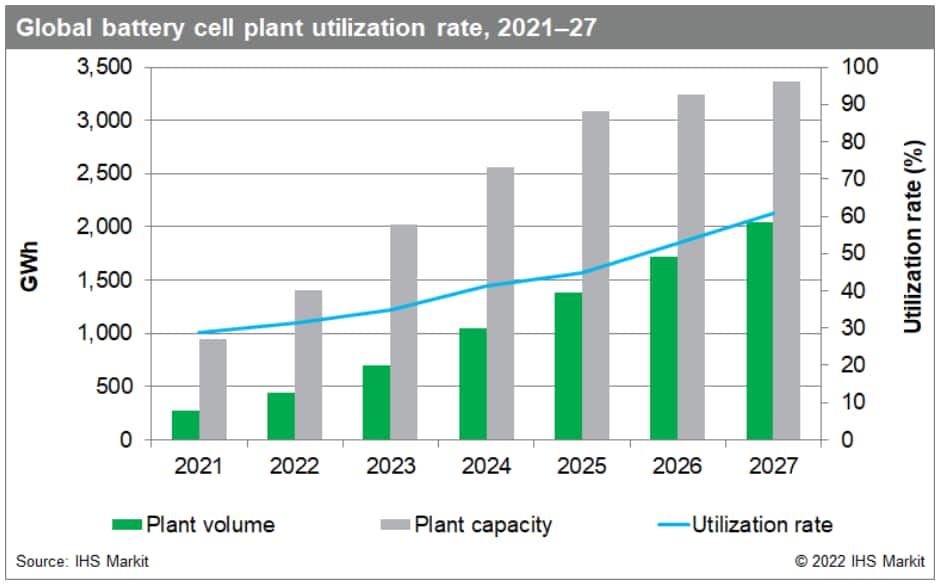
Production Capacity is how much the industries hypothetically could produce if they had unlimited inputs and labor. This is around ~1,500 GWh
Production is how much they actually built. This is ~500 GWh per year.
Production Utilization is production divided by production capacity. Which hovers around 33% for lithium ion batteries right now.
Actual production figures is what matters, not what factories hypothetically could produce if they had unlimited input. Manufacturing costs are only a quarter of the cost of lithium batteries [1]. Battery production is already bottlenecked on the supply of input materials, so growing production capacity is not relevant until the input demands are fed.
I don't think your spglobal link really supports what you're saying:
> According to S&P Global Mobility (formerly IHS Markit | Automotive), demand for Li-ion batteries from light vehicle between 2021 and 2027 will increase a compound annual growth rate (CAGR) of nearly 40% to about 2,050 GWh. Installed battery capacity in the same period will grow a 23.5% CAGR to 3,371 GWh in 2027.
The green bar is actual production (the figure that actually matters). The gray bar is production capacity. Notice how the green bar is one third to one half that of the gray bar? This is why it's important to distinguish between production capacity and actual production figures.
The way you're conflating production capacity with actual production is exaggerating the availability of batteries by a factor of 2 to 3.
I couldn't quickly locate the original source, but in your link the reference to 'utilization' suggests it's talking about how much is used for cars, not how much production is sitting idle:
> Compared with 56% of the installed capacity in Greater China being used for light vehicle segment, Europe will have a much higher capacity utilization of about 74%.
Incorrect, this is about how much battery production is produced in total. The talk about cars is explaining the breakdown of demand.
Show me a source claiming that 1,500 GWh of batteries was actually produced. Not installed capacity. Not demand. Actual production. 1.5 TWh is an incredibly high number, and would represent a 200% increase over the previous year.
This source talks about demand (not production) of 670 GWh for 2022 [1] but who knows how much of that demand was actually fulfilled. But even if it was 100% fulfilled that's still less than half of 1,500 GWh.
The latest data I could find on actual production was 476 GWh in 2021 [2].
Batteries are only going to offer on the order of hours or maybe days of energy storage to manage short term hiccups in wind and sun.
You will always need a backup that can spin up quickly in in the long tail events where you have weeks of not enough sun or wind.
And realistically, you have to exercise those backups regularly to keep all the infrastructure and systems in working order so you aren't surprised in an emergency that the system is broken from months or years of disuse.
That'll be gas peakers until there is so much solar, wind, pumped hydro, and transmission that it doesn't matter. The US currently has more renewables in grid queues (~2TW) than total national generation capacity [1]. Nuclear takes years to build, renewables and batteries takes months. We're deploying 1GW of solar per day globally. Per day. China built more wind this year than the UK's entire generation capacity, and more solar than the entire US solar generation capacity. Battery manufacturing and deployment will come up to speed as the entire auto industry is forced to move to EV production. Tesla's utility scale storage is sold out for another 2 years or so at the moment, the demand for this tech is voracious, which is good; it sends market signals to build more factories faster.
Lots of legacy fossil generation is going to end up stranded [2], from a capital markets perspective. No one is going to touch nuclear with their own capital, the LCOE speaks for itself [3]. Keep existing nuclear running as long as safe, but it'll sunset too eventually. Don't get mad at the math, it's just math.
Again, overproduction doesn't matter unless you have the storage capacity to store it and release it later. Even if you overproduce solar power by 100x you're still not getting any electricity at night from those panels.
Simply comparing production figures without considering intermittency is one of the most common oversimplifications people make in decarbonization discussions.
Solar is limited by available surface area, but more importantly by environmental impact. You're going to start destroying ecosystems if you blanket the land with panels.
Hydro has been mostly tapped out for a long time. At least in the developed world, all the geography that can be dammed, has been. And even here, there's a strong push from environmental groups to destroy the dams to restore ecosystems disrupted.
I share your optimism in most parts but don't agree that fossil fuels will be stranded. Reduced demand will push down prices which will increase demand until a new equilibrium is found that satisfies cost of production. As long as the Saudis can produce oil at 6 USD per barrel and sell for more (80 USD atm), they will sell their oil.
Complex topic. Lets scope to solely the electrical grid for this subthread. Oil is already not competitive in most generation mixes (there are some outliers in Central America, for example). That leaves coal and fossil gas. This generation infrastructure, the burners of these fossil fuels, is what will be stranded.
Indeed there is much work to be done to drive fossil fuels out of all modes of transportation.
"It says most new-build technologies, like renewables, can enter an electricity system and provide reliable power by relying on existing capacity already deployed, but as their share increases, which forces the retirement of existing flexible capacity, the system will find it increasingly difficult to provide reliable power supply without additional investment.
To address that issue, the report calculates the additional cost of making variable renewables reliable at shares of 60, 70, 80, and 90 per cent of the system (the extra "integration costs" consist mainly of new storage and transmission costs).
The report found even when those integration costs were taken into account, the cost range for variable renewables was still the lowest of all new-build technologies in 2023 and 2030."
It’s not straightforward. What is your “X”? Duck curve shifting within the day? Or seasonal storage to account for a no-sun / no- wind black swan week like they had in Germany recently?
If you are just interested in intra-day shift, then battery+solar is already being widely deployed (in a pretty under-reported way IMO). Seasonal is way harder, I think smart grid / demand-side automation could actually be the key to resolving outlier events rather than building mostly-unused peaker plants.
One, it's not just an issue of 12 hours for diurnal storage. There's also seasonal fluctuations, where weather is drastically reducing output for weeks or more at a time.
Second, the US is averaging total storage costs of over $500/KWh [1]. So 12 hours of storage for 2 GWH (total, 24 GWh) would work out to 12 billion dollars. And this storage needs to be replaced every 10-15 years.
Estimates don't include storage because it's incredibly expensive. Renewables are cheap when they're supplementing a primarily fossil fuel grid (or hydro), but they're incredibly expensive as a primary source energy. But they're the cheapest short term carbon reductions, so naturally that's what politics rewards.
Scroll down to page 17. This is for solar + 4 hours of storage. Not the 12 required to satisfy diurnal storage, let alone the days to weeks required to offset the seasonal fluctuations. This is a common way to make storage look cheaper than it really is: create an ambiguous term like "solar + storage", then bury the actual storage duration (often 2 or 4 hours) much deeper in the document.
It's also unclear how they're calculating storage costs. Page 41 lists $178 per MWh. The US is currently building out storage at a cost of ~$500 per KWh so this is an insane cost. Are they projecting this as total cost for storage and retrieval over the life of the system? If so, how many discharge cycles are they assuming? What is the actual construction cost that this report is assuming? That figure seems to be absent from this report.
From your link: "But supply chain issues are expected to begin resolving, and commodity prices have begun to recede, paving the way for more projects to move forward."
It's a bit disingenuous to assume average prices will stay the same when you scale production by several orders of magnitude, as we will with batteries in the next decades.
It's also disingenuous to treat "expected to..." as a certainty. The future will tell whether battery cost will go down. Yes, production is increasing, but so is demand. Especially once EV mandates start kicking in.
I might be misreading but maybe because 100% isn't possible?
"Mind you, the integrated system plan was released last week and it did emphasise that although it is likely to be a renewable future, we'll still need gas as a supporting technology."
Even ignoring times without sunlight they're nowhere close to full renewable saturation anyway (no one is), so considering it's cheaper for the bulk of use it seems like the prudent investment.
Good catch, would be super interested to see this comparison to nuclear. Are we close to equivalent flexibility and lifetime? Including maintenance cost and battery lifetime etc.
There is a reason China has 16 nuclear plants under construction, with plans to start many more, even though they have access to some of the cheapest wind and solar power in the world.
I was wondering if you're aware that China possesses nuclear weapons and the reactors needed to produce more. Also, do you believe that all nuclear reactors function identically, being used for both power generation and weapon creation? And about France, what are your thoughts on their nuclear policies? Do you feel they are continuously producing weapons, or is there just a misunderstanding about nuclear power as a political issue leading to snap judgments?
If you want nuclear weapons it's a good idea to have a nuclear industry so that you have engineers familiar with the relevant technology. I'm not implying that (all) nuclear power plants are weapons factories.
In the sense that they both feed the grid, no. In the sense that they have different costs, risks, yes.
Personally I think that the question, "Which is better?" is pointless. It's much more interesting to ask, "What proportion of each generation method should we target?"
It's then just question of "Where would you put a pin in the simplex of generation proportion?"
The question of the mix is interesting, and probably more complex than it looks as we might have to take the "electrification" of industries, transportation, heating, etc. over time into consideration.
If EV become more popular, if trucks and trains start to use more electricity, if heat-pumps become more popular, etc. the demand for electricity would grow over what the country is currently using. So new capacity would be needed, and electricity would be even more critical and would require to be more reliable than ever before.
That is why nuclear has a part to play to make the grid stable and reliable, on top of renewable deployment.
Absolutely, designing a mix for today's demand is guaranteed failure.
Designing a mix for a target date with predicted demand characteristics actually has a shot at working. We can make quantified statements about distribution estimates for demand that includes quantified variability and create a mix target that meets our tolerance for risk, cost, and sustainability.
I frankly think that armchair debate over solar vs nuclear - which is 99% of these discussions - has exactly zero probability at arriving at an optimal mix. Pigeon, chessboard, &c.
We did not say that there is no wind at night, but it is possible to have no wind some nights. And since at night there is no sun, that is why the price of electricity would go up, if there were not nuclear (or gas/coal) to run during those nights.
The title is misleading.
Only the fairly new and surprisingly expensive SMRs were taken into account, the much cheaper traditional nuclear power plants weren't.
Which could be fine, but then don't generalise your findings across the entire nuclear landscape.
The economics of traditional plants are even worse. They're complicated to build, they take forever to throttle, they need a ridiculous amount of auxillary cooling infrastructure due to crap throttling, and their thermal efficiency is below even fossil fuels since they can't run superheated without making the reactor even more of a maintenance nightmare
For anyone who didn't notice: the CSIRO report above is specifically about the relative marginal costs of building nuclear vs. renewables in Australia.
Australia is in a pretty unique position, energy-wise. I wouldn't attempt to generalize the findings in this report to any other country.
On the nuclear-power side: Australia does have uranium ore deposits of their own. These are currently exported to partner nations. But Australia doesn't currently have any uranium refinement capability. Australia is not a "nuclear nation." Building up such a domestic capability would have large capital costs, and large ongoing operational costs.
On the renewables side: one thing Australia has tons and tons of, is "land with low property values for renewable energy generation to live on." Consider:
• A majority of Australia is nearly-empty "outback." While some of this can be used for farming, most of it is inhospitable even to that use-case. Much of it is hot near-desert conditions, getting tons of sunlight throughout the year — so solar farms are super-effective here. (There is already a huge one in production, feeding energy to Papua New Guinea: https://www.power-technology.com/data-insights/power-plant-p...). And unlike hypothetical proposals to cover the Sahara in solar, the Australian outback is also "close enough" to power demand that it's economical both to visit these farms to regularly to maintain the panels, and to run and regularly mantain HV power lines to deliver the power.
• Because there is so little mountainous terrain in Australia (just lowlands and higher plateaus), Australia as a whole also has high levels of predictable, directional wind — perfect for wind power generation. Same arguments apply for building wind farms as for building solar farms. Put them where nobody's going to compete for the land — probably also in the outback.
• A large part of the Australian coastline is also unpopulated, and undesirable to either population or shipping — being flat stretches of rocky shore without inlets to encourage make commercial/industrial use. This sort of environment, however, is highly economical for wave-power generation!
> GenCost has been advised by stakeholders that small modular reactors are the appropriate size nuclear technology for Australia. Australia’s state electricity grids are relatively small compared to the rest of the world and planned maintenance or unplanned outages of large-scale nuclear generation would create a large contingent event of a gigawatt or more that other plants would find challenging to address.
> In the present system, it would take two or more generation units to provide that role. As such, large-scale nuclear plants which are currently lower cost than nuclear SMR, may not be an option for Australia, unless rolled out as a fleet that supports each other - which represents a much larger investment proposition.
> The second issue is that observations of low cost nuclear overseas may in some cases be referring to projects which were either originally funded by governments or whose capital costs have already been recovered. Such prices will not be available to countries that do not have existing nuclear generation such as Australia.
One of the dishonesties you see from nuclear fans is claiming nuclear is cheap because the operatings costs are low. This is somewhat valid if you're talking about continuing to operate existing plants, but unless you're given new NPPs for free by the Nuclear Fairy, it doesn't apply to new construction.
Electric cars were never economically viable until a crazy person decided to go all in on the economies of scale for battery production.
Part of the problem with Nuclear is that no one right now is building reactors so startup costs are going to be crazy. But we are still going to need electricity in 30+ years from now so I don't understand why people are so opposed to breaking ground on new facilities just because it will take 15 years for them to pay for themselves.
The problem is trying to show a putative experience curve for nuclear is going to require spending something like a trillion dollars. That's not going to be funded just to show that this time, for sure, the nuclear advocates weren't BSing about how cheap it was going to be.
It takes 15 years until they're through the planning phase, another ten to build them, and then they're likely outcompeted by renewables and never make back their cost.
And waste management plus storage. Research the clusterfuck in Germany, where they put metal containers in a salt mine and then were all surprised when they started to rust away. Really shows how carefully and responsible they treat this. Sure makes me want to have another dozen reactors. So, then you need to move it all to some new location. What's a kwh of nuclear if you take into account the cost of storing that safely for hundreds of years?
Nuclear is the perfect example of privatizing profits and nationalizing losses.
Is this about Asse? Then no, they were not surprised when some containers rusted. The waste was primarily meant to be contained by the salt, not by their metal containers; and it was meant to remain there permanently.
Corroding containers was never the issue with Asse, the general instability of the caverns and water ingress is.
Then I focused on the wrong thing, but the remaining facts aren't reassuring either. Long term stability was already a concern when they wanted to declare this a permanent storage, failing to report structural deficiencies when they occurred circa 2007 and as I now found out twice the expected rates of leukemia in the area between 2002 and 2008 while other types of cancer weren't afected, but of course a connection to the waste storage could not be established.
Waste from solar? Just handle it like you'll be handling the much larger volumes of ordinary waste from all industrial activity. It's not like solar is creating some distinctly different category of waste like nuclear does.
You missed the second half of the equation. For the long foreseeable future, solar will still require the use of natural gas for many seasonal events. Nobody seems to worry about storing the waste from that but is very concerned about the tiny amount of nuclear waste.
I didn't miss it, I deliberately ignored it. Short term, the issue is not inherent waste from renewables, it's how rapidly fossil fuels can be displaced. Renewables are massively better than nuclear on that score.
Longer term, gas is phased out, so the waste from it is irrelevant (or, rather, the CO2 was has to handled if any is still burned.) Renewables do not require natural gas. If natural gas is used for covering dunkelflauten in the short term, that can be handled by other non-fossil means (like e-fuels burned in turbines) in the longer term. And this will likely still be cheaper than using nuclear.
Who the hell are these nuclear fans you're definitely totally talking to who pretend nuclear power plants are cheap/free (and also, why are these figments of your imagination accorded representative status for the entire class of nuclear fans?)?
Conversely, they conveniently ignore those when it comes to nuclear as a Hail Mary even though Nuclear has lost the race and won't return. Economies of scale are at work on Solar and Wind which squash any other generation technology.
Spent fuel is a very different pollutant, one that at worst destroys local ecosystems (global impact with fossil) and the hard to handle stuff exists in quite limited quantities. Yes, it's pretty hard to put it somewhere nobody touches it, but it's not like we don't already need to find a solution to that problem.
I was actually talking about spent fuel rods, the kind you put in concrete casks (and yet they will outlive those). Because that's the stuff that will stay dangerous for time beyond human comprehension.
Radioactive water is not usually a concern. There are heat exchangers between an inner loop with a very small amount of water that is radioactive (but not forever or highly radioactive) and an outer loop with just... seawater. Maybe you're thinking about Fukushima, where they dumped a lot of water on an open core?
You do understand that producing zillions of square km of semiconductor and zillions of metric tons of batteries isn't going to exactly be environmentally benign, right?
Although this is about costs in Australia, the article cites a recent decision by a group of towns in Utah, who abandoned a small-scale nuclear energy project, because it was much more expensive than solar[1].
If you are like me and think "but does that include storage?" every time you hear about cost of renewables, this does:
> electricity generated by solar and on-shore wind projects is the cheapest for Australia, even when accounting for the costs of keeping the power grid reliable while they're integrated into the system in greater proportions over time.
If you increase regulation so the time and cost to build a nuclear plant is impossible...then yeah everything else is way cheaper. Not exactly brkeaking news.
Unfortunately the lack of new builds in the last few decades also removed a proving ground for regular cost optimizations and incremental innovations by firms with increasing institutional knowledge. Most other industries and technologies enjoy this benefit as they keep building products.
Green subsidies are peanuts compared to the subsidies that nuclear gets. Half of the DoE budget is nuclear subsidies, and not being responsible for decomissioning/cleanup amounts to a massive subsidy.
The person you were replying to and the article you posted both make a point you're not addressing:
>Critics allege that the most important subsidies to the nuclear industry have not involved cash payments, but rather the shifting of construction costs and operating risks from investors to taxpayers and ratepayers, burdening them with an array of risks including cost overruns, defaults to accidents, and nuclear waste management. Critics claim that this approach distorts market choices, which they believe would otherwise favor less risky energy investments.[15]
"shifting construction costs to ratepayers" is done for pretty much all energy projects. This is like saying gasoline refineries shift their costs to people buying gas at the pump.
Waste management is a total red herring. The total amount of waste the US nuclear power industry has produced fits in a volume the footprint of a football fields and 10 yards high [1]. Nuclear power plants have to pay the cost of their nuclear waste disposal up front, it's already internalized into their costs. We already have nuclear waste facilities dug into bedrock, their actual use is being held up by political posturing.
I'd originally replied without really knowing anything about the topic, just noticed that you were avoiding responding to a specific point. Now that you're using dishonest framing like volume rather than mentioning cost. I looked up the cost, nuclear waste costs massively eclipse all other energy subsidies, the OP was right, and I think you know this based on your failure to respond honestly twice.
> I looked up the cost, nuclear waste costs massively eclipse all other energy subsidies
It's be really good if you shared how you arrived at this conclusion. Because renewables have received $11 billion in subsidies in 2016 alone [1]. By comparison, nuclear waste management is already factored into the up-front costs of nuclear power plants [2]. Deep dig nuclear waste repositories like Onkalo cost less than a billion euros to store decades worth of nuclear waste [3].
I'm very, very interested how you reached the conclusion that the cost of storing nuclear waste "massively eclipse" all other energy subsidies. You are very likely mistaking the cost of managing waste from nuclear weapons production [4], which is distinct from nuclear power generation.
Where I live then mostly yes. I'm sure the construction would require some labor from abroad because which project doesn't nowadays.
But I am not sure what the point is. Wind power doesn't get any subsidies here (since some decade), but there are plenty of companies who build parks. When it comes to nuclear, the (state-owned) company want subsidies because otherwise it's not worth it (electricity will be too expensive). Interest from other companies is basically nonexistent.
The reality in the US is currently the opposite extreme, and advocating for reform does not mean another fictional absurdist extreme. The government can be bad at regulation too - especially when decided solely by a small committee of non-technical representatives and career bureaucrats informed by the news cycle of their time who make decades-lasting rules and ossified agency directives.
Why do you think the rules are decided by "a small committee of non-technical representatives and career bureaucrats informed by the news cycle of their time who make decades-lasting rules and ossified agency directives"?
That would be highly unusual in the US. Most rules are at least heavily influenced by lobbyist paid by the industries.
The headline was already known, the news element of this is that they've projected that even as the renewable rollout continues, and the percentage of renewables approaches 100%, that renewables continue to be the cheapest option