I'm guessing it was top to bottom and then during the modernization process, left to right was added? It's smart that both forms are allowed though as I could imagine modifying a written language takes many years and massive public effort.
Yep, it used to be top to bottom, and the columns were arranged right to left. As a side effect of this recent transition, it's not particularly difficult to read Korean right to left, either.
It's the same in Chinese and Japanese. It helps a lot that the letters are designed fit into individual square blocks. The blocks can be arranged any way you want. There have been internet memes, for example, written to mean one thing when you read left to right and a completely different thing top to bottom.
But yes, Chinese was written top down, right to left. The PRC basically switched over to left-right, top-bottom right away (it kind of went hand in hand with the simplification project). Taiwan for example kept the traditional format for a lot longer.
When I was learning Mandarin in the late 90s, all our imported material from Taiwan was still top-down, right to left.
The traditional way is vertically, indeed, but on occasions you had to write horizontally, which was then usually also done right to left (can still be seen here and there, as I mentioned in my previous comment).
> The traditional way is vertically, indeed, but on occasions you had to write horizontally
There's not really a distinction. Chinese was written in columns from right to left. When the columns were one character long, they were still columns.
To distinguish horizontal writing from vertical writing, you'd need a writing sample that had multiple columns and also multiple rows. (Because, as noted above, there's no way to tell the difference between 1 row of 5 characters vs 5 columns of 1 character each.) As far as I'm aware, traditional Chinese writing is fully accounted for by the theory that it was always written in columns and never in rows.
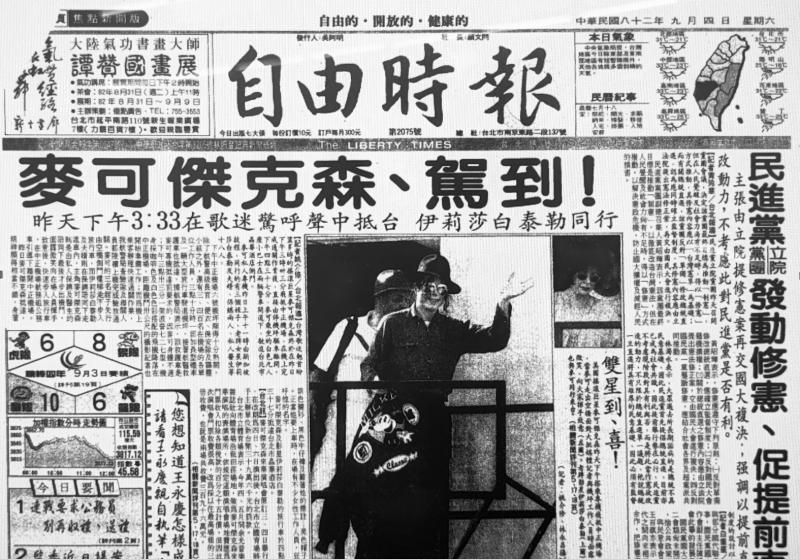
On the other hand, the Taiwanese newspaper isn't making a great case: the "mixture of approaches" used in the headlines are a couple vertical headlines going top down, and several horizontal headings, including the primary headline "Michael Jackson、arrives!", which all go left-to-right. The body text in the infoboxes in the top left and right corners of the page also goes from left to right, though it appears to be true that the article text is in columns. The name of the newspaper (top center) is also printed left-to-right.
At least for Korean, it was right to left only when written top to bottom. Then it changed to left to right. It's never been right to left horizontally. I think it's the same with Chinese. I'm not sure about Japanese.
I've read that there are Arabic-Chinese dictionaries where Chinese is written from right to left to match Arabic direction of writing, but I don't know how common this is.