I know this isn't a very popular opinion, but I've always thought that was a hugely stupid idea in the first place. Instead of shutting down nuclear power plants, we should have doubled down on them and spent more money on research to make them safer (as I understand it, there's still many unexplored concepts to make nuclear power much safer and reduce nuclear waste) and more efficient.
The sad truth is, that decision was largely driven by uninformed and emotional reactions to a single event on the other side of the world. Many people think a nuclear reactor can blow up like an atomic bomb, probably from movies and games as well as just assuming everything "nuclear" is inherently explosive and dangerous.
The amount of money spent on nuclear reactor research is insane. It's very expensive, it takes very long, it requires so much security.
The whole private nuclear sector was heavily subsidized.
And nobody wants a reactor or storage facility in their backyard. Keep in mind Germany has a higher population density than France. And even France has problems to find locations for their new plants.
In the end after Fukushima, there just wasn't enough support left in the population.
I was under the impression that nuclear plants needed to be close to population centers anyway, or at least that it was ideal. The plant closest to my city is about 40km away, easily sighted from one of the city hills here in town.
> I was under the impression that nuclear plants needed to be close to population centers anyway, or at least that it was ideal.
It's the same as for every other power plant. They don't need to be close to their consumers, power can be transmitted for long distances. Of course, there's the cost of building the long transmission lines, and a small amount of power loss (using higher voltages reduces this loss, while increasing the cost of the transmission lines and equipment).
>I know this isn't a very popular opinion, but I've always thought that was a hugely stupid idea in the first place. Instead of shutting down nuclear power plants, we should have doubled down on them and spent more money on research to make them safer (as I understand it, there's still many unexplored concepts to make nuclear power much safer and reduce nuclear waste) and more efficient.
It's a very common opinion among people who have researched this significantly, but not all that common in the general population, sadly.
I make my living off of the splitting of atoms, so the opinions I hear are not reflective of the broader population. It's always interesting to hear what people in the wider-world think. A big part of the perception problem, I think, is that people don't really spend a lot of time to do significant research about how power is made. This is understandable--the power industry is kind of setup to keep the generation side hidden (both physically and figuratively). All most people really need to know is that when they plug it in to the wall, electricity will flow from somewhere and their vacuum (or whatever) will work. I suppose that's something that needs to change.
I also wish it were more practical for interested people to tour operating nuclear power plants. They're amazing feats of engineering and operations--and that's very evident everywhere you look at most plants--but they're not so easy to visit for most people.
> They're amazing feats of engineering and operations [...] but they're not so easy to visit for most people.
Why is that knowledge important for a risk analysis?
Also, renewable power plants of all types (wind, solar, water, etc.) are also amazing feats of engineering. So I don't see this impacting the argument in any particular direction.
>It's a very common opinion among people who have researched this significantly
The nuclear industry has spent a lot on PR to convince the public that they're safer but so far criminal liability for accidents is still minimized and the liability cap (i.e. free government insurance for accidents) is still incredibly low.
I'd personally be more convinced of their frequent protestations that they're 100% safe if they lobbied to increase their own liability rather than engaged public relations firms to put a happy face on their industry.
Actions do speak louder than words, don't you think?
Moreover, if you raised the liability then the research into making them safer ought to more or less take care of itself. The greatest incentive for executives is avoiding criminal liability.
Renewables aren't explained any differently though; and many people, sadly, don't really care to listen to any explanation; they just have an image in their minds and are happy with that.
Nuclear simply is too expensive. France is a good example: Most of the energy in the country is created by nuclear plants, which are old now and have to be decomissioned. Compared to other countries nuclear has an ok image in France, yet they don't plan to build new plants.
The Flamanville site is in the process of building an EPR unit, and already has 300% cost overruns [0].
The official prognosis for 6 new plants (to replace the old ones) has put the sticker price at $51 billion [1] - without any cost overruns, without waste disposal and without decomissioning of the plants - each of which adding billions per plant. Including these costs, utility scale wind turbines are roughly the same price, at about $15-20 billion per 1000MW.
Actually, they do: "In this study, benefits of interconnecting wind farms were evaluated for 19 sites, located in the Midwestern United States, with annual average wind speeds at 80 m above ground, the hub height of modern wind turbines, greater than 6.9 m/s (class 3 or greater). We found that an average of 33 % and a maximum of 47 % of yearly-averaged wind power from interconnected farms can be used as reliable, baseload electric power."[0]
The more turbines, the higher that percentage becomes. (For comparison, French nuclear plants also only produced power a bit over 70% in 2016/7)
United States is somewhat bigger than France, which is why it somewhat works. Somewhat because the base load achievable by such balancing is rather small. And by adding more plants you make the crest factor in this estimate higher...
Europe is actually better in this regard because of grid connections between the countries. So lack of wind could be compensated by imports from Spain or Germany, for example.
Germany and Norway also currently work on a project for a direct connection between their respective grids, called NordLink.
> The sad truth is, that decision was largely driven by uninformed and emotional reactions to a single event on the other side of the world.
Actually it's completely the other way: in Germany an informed population discussed this topic for two decades and eventually a consensus in society emerged to slowly phase out nuclear first and to create a new, renewable and market-oriented energy landscape.
In Japan an uniformed population was surprised to learn over night that a single event can take out all their nuclear power plants for months & years and can cause for many of these nuclear power plants their sudden end of life. They were also surprised to learn that cores can melt in nuclear power plants and that the industry and regulators have no idea how to handle that.
That's not quite correct, politics and electability of stances on the topic play a big role, even in Germany.
In 2001 socdem-green coalition agreed on an "Atomaustieg" that would not allow new plants to be greenlighted and the old ones would be phased out by some time 2015–2020.
In 2010 when Merkel first had a sole conservative-liberal coalition, those plants got an extension for another 8 years and even an unpopular "Austieg vom Austieg" (exit from exit) seemed viable.
It was only in 2011, as a direct consequence of Fukushima that Merkel's stance changed (or she saw an oppurtunity to push through with it, if that was her personal preference).
In my opinion, she saw that an "exit from exit"-stance would have endangered her re-election. So it was a largely political driven decision, regardless of what the educated concensus in Germany was. It took away a main attack talking point of the green party, which was polling at about 25%* in post Fukushima-2011, realms the green party only got back in only 8 years later, in the wake of the climate crisis topic last year.
Saying that Germany's handling of the energy sector is purely rational, simply doesn't hold up to the political realities, which can be quite messy.
> In 2001 socdem-green coalition agreed on an "Atomaustieg"
After two decades of discussion and political struggle.
> Merkel's stance changed
Merkel knew already that there was not enough support for nuclear. The Fukushima event caused the collapse of the nuclear support in her own party and in the industry.
> Saying that Germany's handling of the energy sector is purely rational, simply doesn't hold up to the political realities, which can be quite messy.
No human decisions are 'rational'. Energy politics is never rational. Every decision in energy politics is guided by current level of knowledge, political influence, influence by industry (their are billions of dollars involved), various preferences, etc.
The German population was never asked if they wanted a monopolistic and centralized electricity system - the one which emerged after WWII. Some politicians even thought that nuclear technology was a step into military power. This was for example the plan of Franz Josef Strauss, a very influential politician at that time.
in reference to 2001 this sounds about right, sorry just was confused which time span those 2 decades refer to.
propably even 2 1/2 decades or more, the big demostrations started about 78/79.
I'm of the opinion that nuclear reactors are generally safe when good engineering and operational practices are adhered to, and do understand that they're a reliable, significant power source.
The main two issues which lead me away from nuclear at the moment are:
- Externalities: even though I've read about various ways to store/dispose of nuclear waste long-term, I've yet to hear of a solution that seems clearly safe -- especially compared to the alternative of not producing nuclear waste in the first place.
- Cost: From what I've seen, Levelized Cost of Energy (LCOE) seems a standard measure for overall cost of energy production by source, and as of relatively recently, it seems that wind and solar are generally[0] now cheaper than nuclear.
If it's cheaper and externality-free to pursue renewables, that seems like a pretty strong anti-nuclear argument.
I'd agree there's also a larger real-world audience to convince one way or the other -- but I'd also be wary that they'll accept equally spurious arguments about wind/solar not being workable.
I think brief 'talking points' end up being pushed by industry a lot to try to influence people in one way or another - and that those end up flowing through communities and social networks and defining people's 'default' reaction in debates based on cherry-picked arguments even if they haven't had time to read further about the issues.
> Externalities: even though I've read about various ways to store/dispose of nuclear waste long-term, I've yet to hear of a solution that seems clearly safe -- especially compared to the alternative of not producing nuclear waste in the first place.
Nuclear waste used to be my main reason for not liking nuclear power. The thing is, if you're gonna argue that way, what about CO2? It stays in the atmosphere for far longer, unless we find some good way to actually put it underground again, which atm wejust don't.
The benefit of nuclear waste is that there's far less of it, so putting it underground is actually viable.
And it's not even like renewables don't have their own environmental problems; just look at how many bats and birds are killed by wind turbines.
Germany did have a thorium based reactor, it had multiple incidents and was never profitable.
It was only online for two years and was eventually torn down. Well, the cooling tower was, they still have to wait for the reactor to lose it's radioactivity.
Long time ago there were utterly rosy predictions how simple and safe pebble bed reactors would be. Then they built that thing. I have this theory that the conventional wisdom is wrong. The people that designed the basic reactor design used to day were very very smart and had lots of resources. And that the best design they could come up with. Since then all the other proposed designs come from pollyanna B team types.
Bill gates documentary on Netflix was really, really interesting and touches this. Even made me appreciate Bill Gates which I didn't think was possible because of Windows :-)
Basically all the reactors involved in the incidents are based on very old technology and had design problems (which is not surprising as the technology and science was new at the time these were built - fukushima 1971, chernobyl 1977).
What we really should do is to work on reactors whose main functionality is to provide energy with extremely minimal possibility for meltdown. It's too bad that even with resources of Gates it seems to be impossible to advance the nuclear technology - I see it as the main way to save our planet.
It must be a deliberate tactic of the anti-nuclear lobby, to simultaneously block new reactors being built and complain that old reactors are obsolete. There is no other explanation that makes sense!
But that's not what happened. Fukushima merely turned the Merkel-governments attempts at weakening the already-decided and widely supported exit plans (which had been created following decades of a slowly growing anti-nuclear movement) from unpopular (even before Fukushima, a majority supported the existing exit plans and disagreed with the Merkel policy) to entirely politically nonviable.
But somehow people think one headline from back then constitutes the entirety of German nuclear exit policy, and keep repeating this everywhere...
I'm not disagreeing, just pointing out that when the grandparent post says "emotional reactions to a single event", they are talking (correctly or not) about the Fukushima event, not Chernobyl.
A response that "Chernobyl wasn't on the other side of the world" is either misunderstanding which event entirely, or skipping a whole lot of necessary preamble about it not being a "single event" at Fukushima.
If I remember it correctly, almost nobody was talking about Chernobyl at the time because everyone knew that was just a mix of stupidity and the level of understanding at the time just being vastly different from today.
If I remember correctly the German public was very well aware of radioactive pollution and the fact that many old and unsafe reactors were operating in and around Germany.
For example in Greifswald an electrician caused a damage of roughly 500 Million DM on a reactor, by doing a demo creating a short circuit.
Again, this is just how I remember things, but I think many people weren't convinced that something like chernobyl could still happen with "modern technology" (whatever people imagined that to be) and it was mostly fukushima that proved to them that the danger hadn't gone away over the years thanks to some abstract notion of "technological progress".
That's what I mean by "single event". Of course, the informed person would not have made a decission based on just that one incident, but it's what I suspect large parts of society did.
Three Miles Island was widely discussed. I don't think people thought that this could not happen here. Just the opposite, since a lot of the early nuclear technology and plant designs in Germany came from the US.
I think lots of people were aware that complex technology has lots of risks which were there, but largely ignored. The industry claimed that they can handle the risks it was willing to handle and/or which were thought to be actual risks. There are a lot of risks associated with large/complex technical systems, caused by natural disasters, malfunctioning technical systems, aging technical systems, users making unintentional errors, users making intentional errors and bad actors. Some of these risks were just ignored. For example for many years nuclear power plants were built with no or very weak protection against plane crashes.
For example, how realistic is the risk that a large passenger aircraft can/will be flown into a nuclear power plant? Military planes will then shoot it down before reaching a plant?
Before 9/11 many in the industry would have thought that this risk is nothing they need to deal with and only small plane crashes were thought to be important to deal with. Then also a Lufthansa pilot was flying a plane into the ground and crashed it in France, killing all people on board. Once those events happened, the regulators take it much more seriously - even though parts of the public was already thinking that these events are possible.
If the owners of fosil fuel power plants were made to pay for all the damages they're directly and indirectly causing, I'm pretty sure they'd suddenly like nuclear power a whole lot more.
No, I agree. I really think there should be a big green push for new nuclear. Part of me also thinks that the new nuclear sites should be in city centres, next to the parliamentary buildigs - to really focus minds on safety.
But before Fukushima, it was mostly an empty statement of intent. The nuclear industry was already winding down, but not really because they were taking the decision for granted, they were just assessing the tiny (at the time) risk of it not being reverted as too much for them.
Fukushima changed the perception of exit plans from "yeah, right, I'll believe it when I see it" to "yeah, definitely". Fukushima hit hard because before that, Chernobyl was quite successfully framed as a failure not of nuclear technology but of Sovietism. But Fukushima happened, of all countries, in Japan, famed for accuracy and reliability (they can even run trains on a schedule!) and full of respect for the limited land-mass they have (compare Shintoism to American "exploit and move on"). If they can't handle it, nobody can. A lot of people were reevaluating their perception of Chernobyl and so their personal "disasters in my lifetime because nuclear is hard" counter did in effect not double from one to two, it, jumped to two straight from zero. Opinion shifted from almost a tie to almost unanimous.
By ”can't handle” people mean an incident similar in scope to a mine collapse or coal plant fire. The fires of Saudi oil fields were more toxic than that. People do not understand the kind and level of risk posed by radiation at all - Fukushima was cleanly contained, despite multiple safety systems failing. (Compared to TMI or Chernobyl especially.) The evacuation caused more harm than the incident, as does the sigmatization of the people <not really) affected by it. And it got hit by a tsunami, not a risk in Germany.
This is how overblown the whole affair is.
Yes, wind and solar are safer. So is geothermal. But nuclear is still safer than hydroelectric, gas, oil or coal.
Nuclear energy has never exceeded a few percent of the world energy production. Most of it is heavily government subsidized and/or part of nuclear weapons programmes.
Since Uranium is a finite resource, it is not at all clear if supplying the world's demand using nuclear power would be sustainable for more than a few years. Many types of breeder reactors have been proposed and tested over the decades, but so far with very limited success.
In contrast to relying on true regenerative sources of energy, this makes a full commitment to nuclear energy a huge gamble. On top of that, the nuclear waste problem is still largely unsolved. All attempts at long term storage in the German nuclear programme have ended in extremely expensive failures.
There is lots of Uranium in the sea and we use it very inefficiently at the moment, so potentially Uranium based power can be sustainable almost indefinitely.
I recommend reading this chapter from "Sustainable Energy - without the hot air" by David JC MacKay if you want to know more (with calculations!). It is an excellent book for reading about the facts of energy generation.
Sure, there are plenty of interesting proposals for Uranium extraction and breeders. What worries me is that despite decades of large-budget research, most of them have never been successfully demonstrated. I don't think that hoping for all the technological problems to disappear is a very good strategy.
On top of that, even with current easily accessible Uranium sources, nuclear energy is significantly more expensive than both fossil fuels and renewables. I don't see that getting better with even more complicated reactor technologies.
I can't tell if it's achievable, but if it works, in the long term it could also be something to export to other countries, maybe getting some return of investment that way.
But yeah, just building safer reactors would have been less of a gamble in the short term at least.
It is easy and only a political issue, because of the coal workers, but just do like England and switch to fossil gas, it will be more useful with intermittent wind and solar, but only moderately helpful for CO2/CH4 emissions, and doesn't lead to deep decarbonation, where the only solution is a major nuclear mix, or more realistically for Germany with major renewable load the use of batteries storage for daily intermittency and hydrogen in salt caverns for seasonal intermittency.
It seemed really expensive in the beginning, but now even more so, given they'll do it 5 years faster. I wonder if the investment pays off as it's implemented. Or does it pay off at all? It's really cheaper to move from coal to other ways of producing electricity? I'm asking about the current state of things because I'm sure in the future it'll be cheaper and cheaper
With the current CO2 certificate price it's doable and that price is only going up. Germany reduced carbon emissions by roughly 10% over the last two years. [0] The German "Energiewende" is mostly an example that politicians and the coal industry are slowing down technological progress. From 2008 to 2018 there was a whole decade of stagnation and suddenly they manage to trim the fat in just two years? CO2 pricing works extremely well but only if the price is high enough and only if the government isn't actively trying to dismantle the green tech sector.
it's not expensive considering the alternative is we all die in a giant fireball.
edit:
Also currently on HN frontpage is "Climate threats now dominate long-term risks, survey of global leaders finds" so maybe adverting that is worth the cost.
Hyperbole like that will only lead to the rest of your arguments getting ignored. Even Venus, with its runaway greenhouse effect, is not a "giant fireball" (we even have pictures of its surface).
Something that irks me, someone working in the energy industry, is HN's (and reddit's) obsession with "baseload generation", throwing that term around without really understanding it.
It irks me because there is no such thing really. "Baseload" is the lowest point demand reaches during the 24 hour cycle. At all other points in time it is basically a number on a sheet.
What is needed, is enough dispatchable generation to cover lapses in renewable output, keeping blackouts to an "acceptable" level. Such dispatchable generation does not necessarily need to be large thermal plants.
The bigger reason why there is not much new nuclear, is not political reasons but rather the fact that nuclear is simply uncompetitive with other fuels, including wind. Given that wind power is only increasing, investors don't want to invest into a nuclear plant, then wait a decade for a plant to be built that ends up rarely selling power because other power sources always undercut them.
Germany invests in energy storage technology to harvest cheap surplus energy from the renewables and balance supply and demand over time. The spot price for electricity here reliably oscillates between 30 and 50 € / Mwh per day, with occasional periods with negative prices on windy/sunny days. Energy storage can be used to pocket the arbitrage, so there is a direct incentive to deploy it.
France will not have plenty of nuclear power to spare, many reactors are old and there is no plan to build more of them. In a few decades most reactors will have to shutdown because these things don't live forever.
They don't even have enough spare capacity now. I think I remember reading that when peak loads were particularly high recently, they had to import power from Germany.
Not yet, but Datteln 4 (i.e. the fourth block in the Datteln power plant) is set to open soon. The operator has committed to taking blocks 1-3 offline and argues that the new block will be more efficient than the old ones.
> Looks like they'll still be on coal when most of the world will be moving off it.
That's only true if most of the coal-using world excludes the 2.7 billion people living in China and India, neither of which have any plans to phase out coal at all. The US is also only gradually phasing out coal, it'll still be a major coal energy producer 20 years from now (probably 15% of its power base at that point).
China is very aggressively expanding its coal use - despite using as much coal as the rest of the world combined already. It's presently adding more new coal generation than exists in the entire EU.
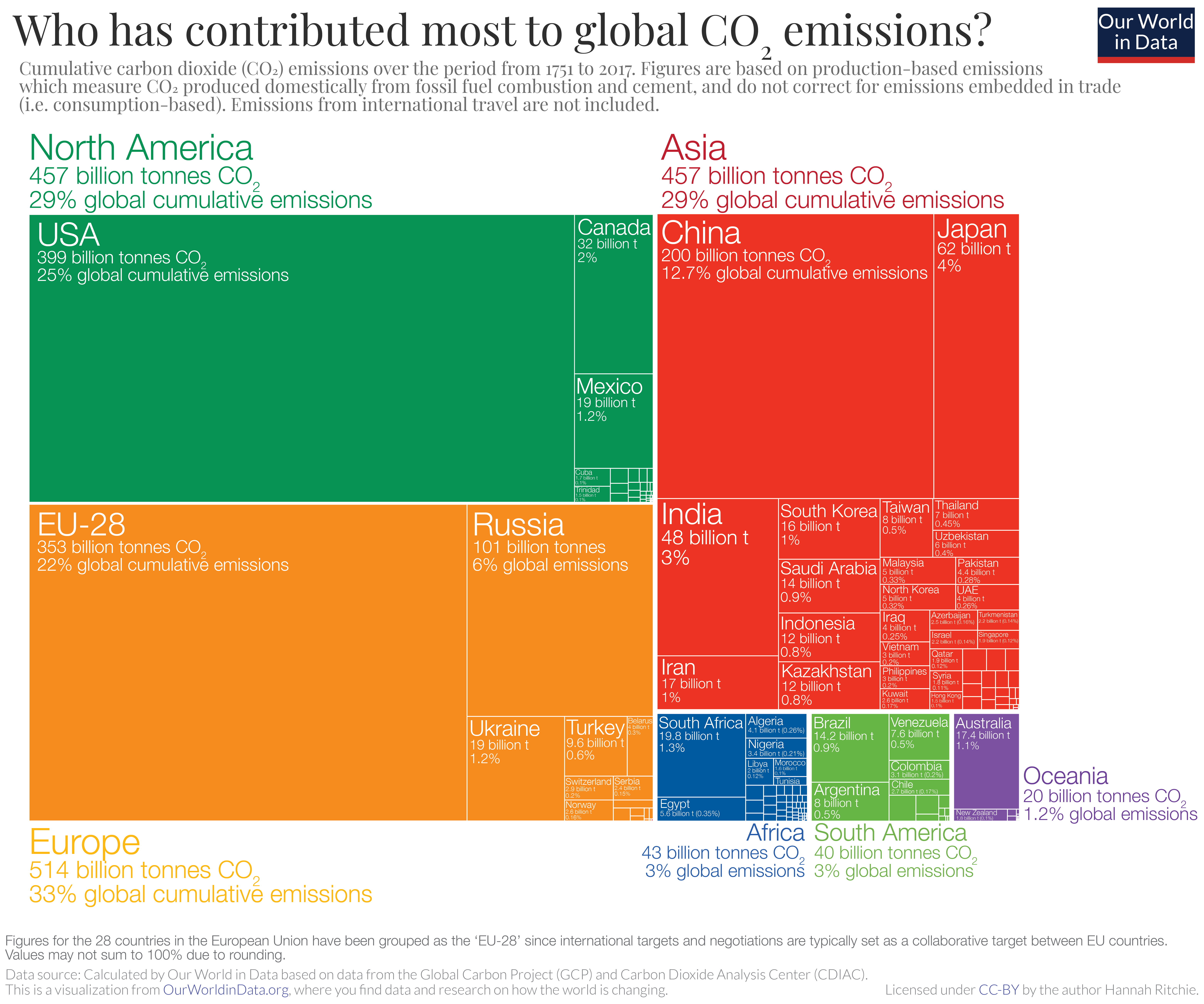
That is true but I often see this used as a justification to not cut CO2 emissions because the "largest" emitters are growing their emissions. However, it doesn't make sense in terms of fairness because if you only look at current emissions you will not see the whole picture. When talking about fairness you always want to consider the cumulative CO2 [0] emissions that a country has emitted over it's existence and in those charts China is still a relatively small player despite having 1.3 billion people. Roughly 14% of the emissions in China are caused during the manufacturing of exported goods. The country is investing in electric mobility and renewable energy as much as it can. The only thing you can do to prevent an increase in CO2 emissions in China is to invent new technology that reduces CO2 emissions in a cost effective way. That won't happen if you just stick your head in the sand and continue defending obsolete technology.
> China is very aggressively expanding its coal use - despite using as much coal as the rest of the world combined already. It's presently adding more new coal generation than exists in the entire EU.
That's today, given the pace China works at they could easily commit to phasing out coal by 2037 and mean it too. They've already started planning for moving on from it. It's also entirely likely they could have less coal use (excluding steel and industrial uses) than from power stations than Germany in 2037 (1 year before Germany commits to phase it out)