I'm actually in Barcelona at the moment, and it's definitely been easy to walk around, but that could also be because the touristy areas near the ocean are very dense, and day to day living north or west of that hub might be different. Besides the giant blocks for walking (I'm not sure I've found a "superblock", but the blocks I've walked on are huge), there are an incredible amount of mopeds. That seems to be a default way of getting around town for locals. That's a big difference than bikers who have to worry about bikes getting stolen, mopeds are probably going to be safe where you leave them, and people here are able to leave them pretty much everywhere. Movement in the city seems very easy for sure.
Side note, anyone here work at or know about Pier 01 down near the water? I just walked by there and was wondering what kind of companies were located there.
:) mopeds (or rather "scooters" and "vespas" in Italy) get stolen left right and centre. They are used more than bikes simply because they require less effort - they are the closest modern equivalent to horses, the transportation method for which old European cities were actually built.
> they are the closest modern equivalent to horses
I'm not sure how you're making this comparison, but if we're gonna compare machines to horses, the bicycle was invented in the 19th century to compete with horses, before automobiles were invented.
His comparison makes sense to me. When you ride a horse or a moped, you aren't putting the effort into it, something else is. When you ride a bike, you're putting the effort into it. It's definitely a difference. I enjoy a 10 km bike ride, but it definitely takes effort, and I'm not likely to do that if I'm going somewhere I'm not willing to show up sweaty too. It's a completely different consideration on a moped (or a horse, but who has a horse these days anyway).
I know a little about Pier 01. It's full of Barcelona and international startups, and I believe it's part of the Barcelona Activa city project to develop entrepreneurship. There's a French accelerator called Numa opening there and a bunch of other companies. I can find you someone to talk to there if you want.
I was there a few days ago and while walking around the Encants neighborhood, I was using a maps app and looking at the block I was on, which showed a hollow interior (similar to that seen in overhead shots of BCN). But I don't think that makes it anything more than just a block with a unique design.
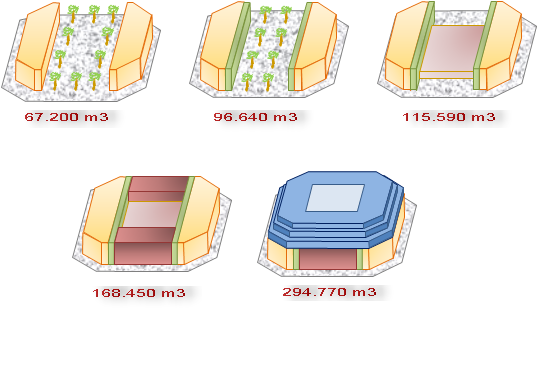
Like you, I didn't find a superblock but I think that's due to it being a concept and not something you can necessarily visually see (as explained in the somewhat recent Vox video).
But actually, super blocks aren't closed to traffic, they enforce slow traffic speeds -- like 5MPH. A van could still cruise by at 5MPH and steal a moped,
but it would be super obvious in a crowded super block.
In terms of the obviousness of a crime, is there any word as to correlation or causation for street crime vs. pedestrian traffic? My gut says that busier streets lead to fewer crimes, but I'd like to see numbers on that.
Modern Vespas actually have an immobilizer device that prevents the scooter from working without the right transponder key, so it's even more difficult than just "hot-wiring" them.
Interesting about the north and south discrepancies where they say that property is more valuable on the north side of town. I was just thinking about this in terms of how cities are laid out. The two cities I know are Milwaukee and Chicago and it is pretty obvious that the north sides of each of them are way more affluant than the south. Any other examples of this or am I off base?
Yes, Minneapolis is a correct counterexample. What matters most for house prices in the Twin Cities is nearness to lakes. North Minneapolis has few lakes, the highest crime rate in the city (with a murder rate far higher than, for example, New York City), and blighted public schools. Southwest Minneapolis (same municipal government and same public school district) is a desirable neighborhood near lakes with a lot of high-income residents and a high school that is a feeder school to the Ivy League.
Counterexample: the northernmost part of New York City is the Bronx, which is far from the priciest. (Inwood, the northernmost part of Manhattan, also isn't as expensive as portions of the island to the south.)
Assuming you already know jQuery (since most everyone who works with js does), what benefit is there to learning YUI over the jQuery based frameworks? It seems like you would have to learn something new and complex anyway.
What a joke. If EPEAT doesn't overturn this rating, all credibility should be out the window. It seems like Apple is trying to strong-arm them into changing the requirements so the laptop complies.
> Apple declined to comment specifically on how it believes the Retina MacBook Pro meets the EPEAT criteria, but referred us to SVP Mansfield's letter from Friday, which noted that the company in looking forward to "working with EPEAT as their rating system and the underlying IEEE 1680.1 standard evolve."
Depending on the situation, I might be ok with fingerprint access (such as high secure areas and such). The problem is for normal everyday use, I wouldn't be able to tell where the data is going. Either the manufacturers themselves or governments or hackers could be storing the data about who enters which door and when which would be another attack on my personal privacy that I don't want to give up.
I really like the last point about leaving out cool stuff because its not resume material. When learning about resumes in school, it seemed like the teachers would always try to have me recreate the "standard" resume basically from a template because it was the "right way to do it". In reality, a resume is just a way for the company to get to know you and your abilities/accomplishments and as long as the resume is clean and understandable, you should feel free to anything that could help your case.
Yes, exactly. The nice thing about tech companies is that they're very casual, and really not caught up in "rules" about resumes. (That said, many resume rules do exist for good reason.)
If your a government employee and something goes wrong you just claim that you didn't have enough money or resources to do the job. At least that's what everyone seems to do and they get away with it.
Agencies can claim that. Because we never fire or sideline agencies.
But individuals don't have the same out. Somebody who took a risk and failed may never get fired, but for somebody with ambition and vision, getting demoted to a pointless job with no power is worse than getting fired.


Side note, anyone here work at or know about Pier 01 down near the water? I just walked by there and was wondering what kind of companies were located there.